





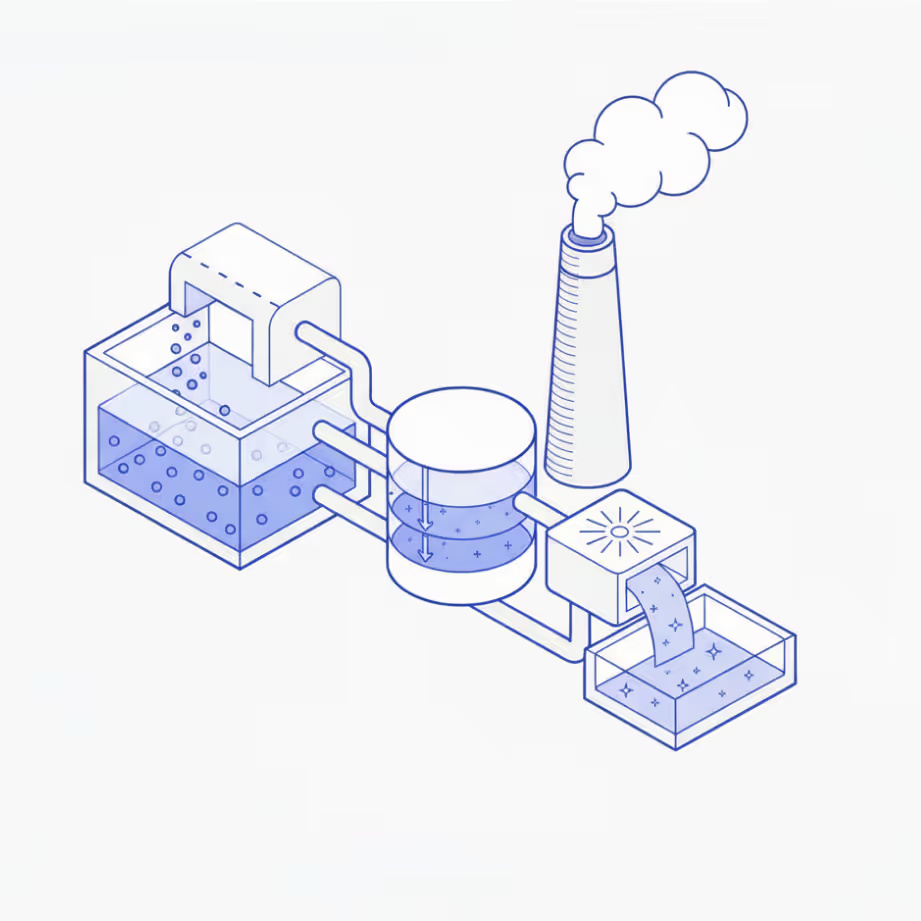
In water treatment and environmental control, calcium-based materials regulate process acidity, capture gaseous contaminants, and restore water chemistry stability. Feed purity and particle size affect reaction kinetics and dosing consistency. Variability in input material introduces instability in treatment performance. Controlled calcium inputs support predictable outcomes across effluent treatment, scrubbing, and water conditioning.
Current applications supported by our lime products
Effluent Neutralisation & pH Control
Application context
Process impact
Common requirements
- Maintains stable pH levels
- Improves heavy metal precipitation
- Supports effective sludge conditioning
- Reduces chemical dosing variability
- Ensures consistent discharge compliance
Applicable products
Flue Gas Desulfurisation (FGD) Sorbent
Application context
Process impact
Common requirements
- Optimises Ca/S ratio for peak capture
- Reduces sorbent consumption per cycle
- Minimises internal scaling formation
- Enhances reagent utilisation efficiency
- Ensures continuous emission compliance
Applicable products
Water Conditioning & Remineralisation
Application context
Process impact
Common requirements
- Restores treated water mineral balance
- Improves clarity and acceptability
- Enables precise conditioning dosing
- Prevents distribution pipeline corrosion
- Sustains long-term water quality
Applicable products
Qualification and technical support
Materials are produced under defined process parameters and supported by technical documentation for evaluation and qualification.
Defined material specifications

Controlled processing parameters
Batch traceability

Technical evaluation support

FAQs
If you have questions about lime products, specifications, or typical applications, the answers below address some of the most common topics. For anything more specific, our technical team is happy to help.

Why is limestone the preferred choice for pH correction in industrial effluent treatment?
Limestone delivers controlled, low-hazard neutralisation with stable buffering behaviour, ensuring consistent dosing performance across varying effluent loads without the handling risks of caustic alternatives.
How does particle size distribution influence scrubbing and sulphur capture performance?
Particle size distribution governs reaction surface area, dissolution kinetics, and sorbent utilisation. Controlled gradations maximise capture rates and reduce material consumption in FGD and wet scrubbing systems.
Can high-purity limestone improve potable and process water stability?
High-purity calcium carbonate rebalances mineral composition, corrects water chemistry indices, and provides long-term chemical stability for both municipal water conditioning and industrial process water treatment.