





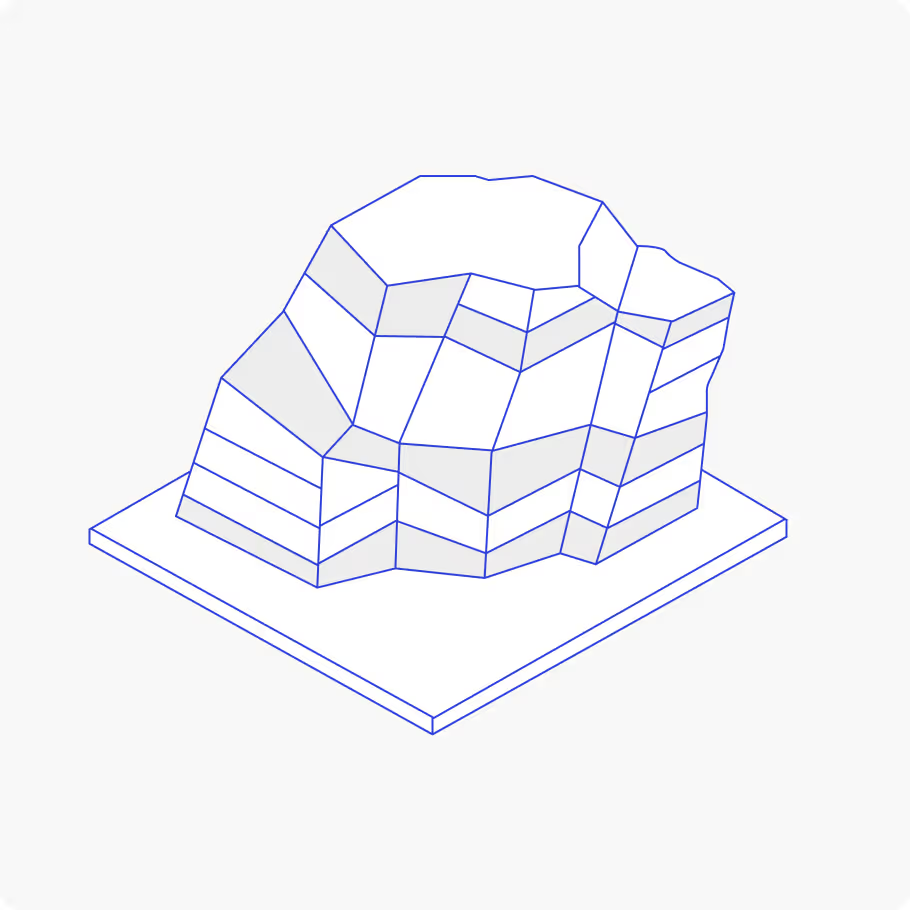
Isometric line drawing of a multi-faceted lime rock on a rectangular base.

Limestone products

Single-source chemical-grade limestone structured into industrial-grade outputs.
Arrow pointing down
Explore its role in the industry

What is limestone

Limestone is a sedimentary rock composed primarily of calcium carbonate (CaCO₃). At industrial scale, performance depends on chemical purity and consistency. Our material originates from a controlled, single-source deposit with up to 96% calcium carbonate content, enabling defined chemical input and predictable industrial behaviour. From this mineral base, limestone is processed into calibrated industrial grades used across mineral-based and high-temperature systems.

Engineered through
defined stages

1

Source Control

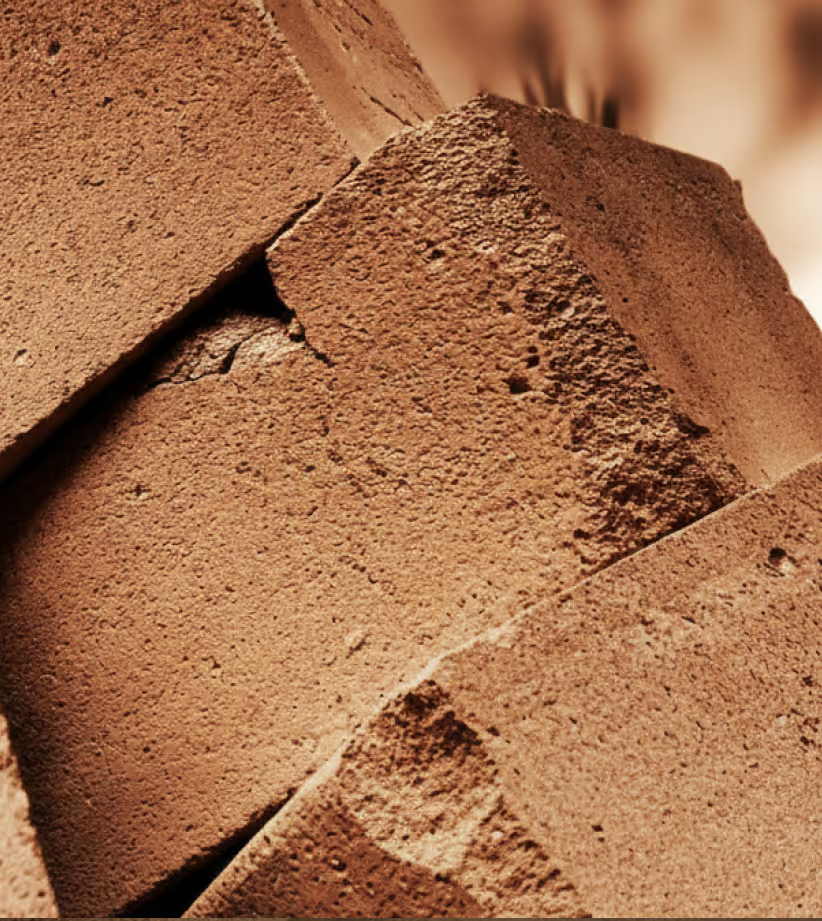
High-purity reserves are selectively extracted and pre-classified at the mine site to ensure consistent chemical composition and raw material integrity before entering the processing stage.
Close-up view of beige limestone blocks with textured surfaces and defined cuts.
2

Purity Enhancement

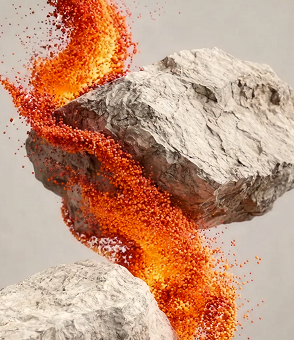
Material undergoes advanced optical sorting to enhance chemical consistency and remove off-grade fractions based on color and compositional parameters. This stage improves baseline purity before mechanical processing.
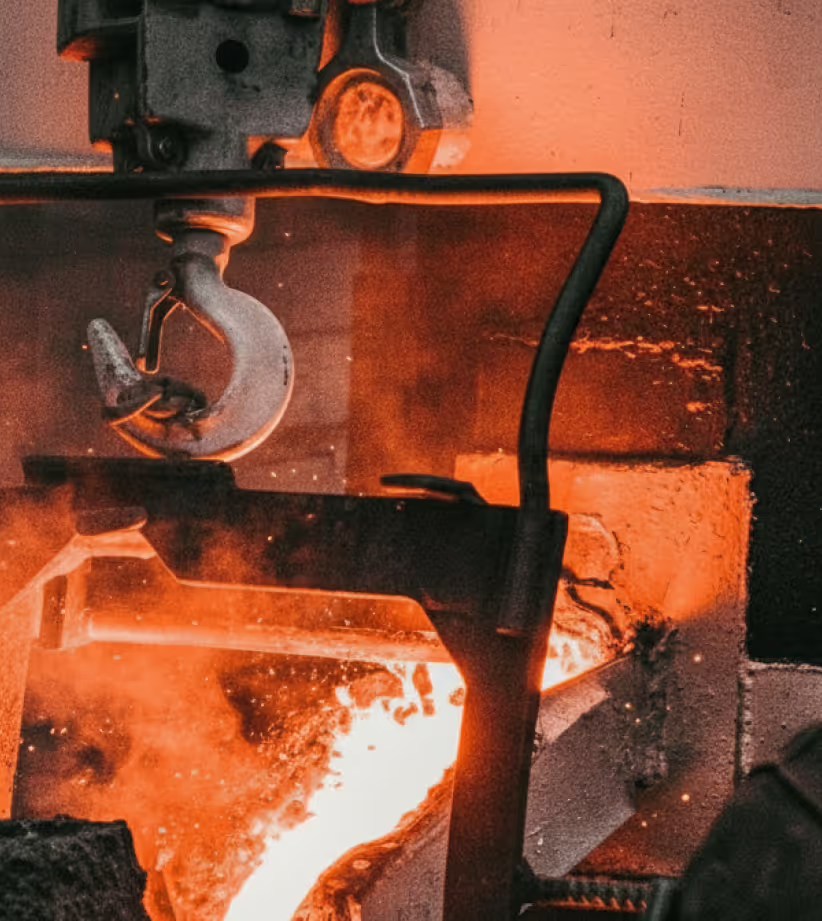
Fiery lava flowing between large gray lime rocks.
3

Precision Size Engineering

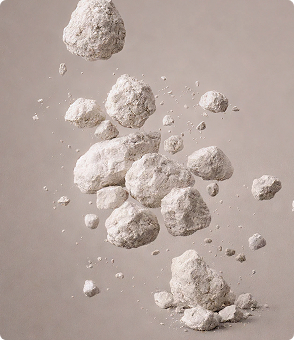
Advanced milling and high-efficiency screening systems define target particle populations and controlled size distribution windows — forming the basis for application-specific performance.
Clusters of white powdery lime particles floating against a neutral background.
4

Impurity Control

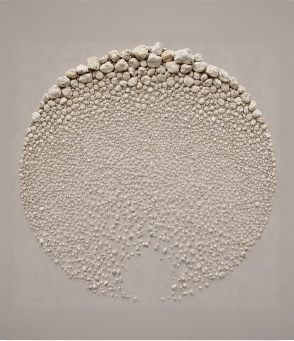
Multi-stage high-intensity magnetic separation removes ferrous and paramagnetic impurities, achieving ultra-low iron levels and ensuring high chemical stability.
Wall art sculpture of a circular tree made of small white rounded lime stones on a beige background.
5

Defined Particle Distribution

Final material is digitally managed through SCADA-driven batching systems, guaranteeing volume-based particle size distribution control and consistent dispatch quality across shipments.
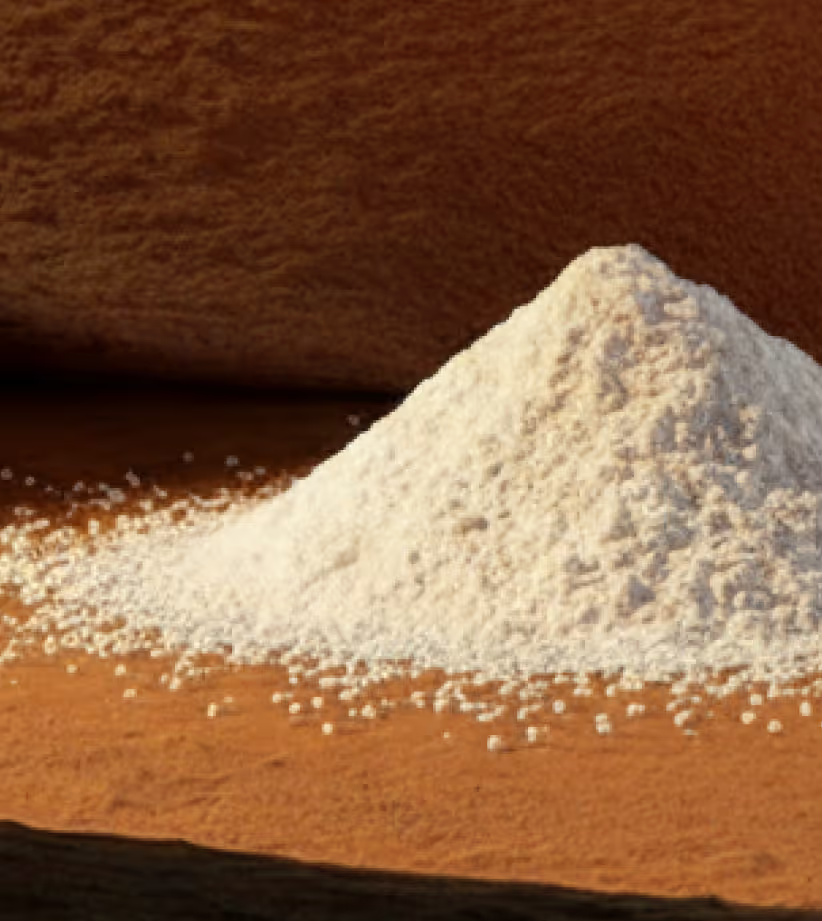
Close-up of textured white lime powder with peaks and valleys creating a mountainous landscape effect.
Close-up view of beige limestone blocks with textured surfaces and defined cuts.
Fiery lava flowing between large gray lime rocks.
Clusters of white powdery lime particles floating against a neutral background.
Wall art sculpture of a circular tree made of small white rounded lime stones on a beige background.
Close-up of textured white lime powder with peaks and valleys creating a mountainous landscape effect.

Functional roles in industrial systems

Limestone provides defined chemical input and controlled particle behaviour across high-temperature and mineral-based systems.

Raw Mix Optimisation & Calcium Control

Role in the process

High-purity limestone supplies the calcium oxide required for calcination, hydration, and chemical synthesis operations. Consistent input chemistry directly determines lime yield, reactivity, and the quality of downstream products including quicklime, hydrated lime, and PCC.

Why it matters

Feed purity governs every stage of the conversion process. Impurities in limestone introduce variability in calcination behaviour, lime reactivity, and downstream product consistency. Controlled composition is the foundation of repeatable process outcomes.

Common requirements

  • High calcium carbonate and calcium oxide purity
  • Low alumina, silica, and magnesium to minimise process interference
  • Consistent chemical composition across batches
  • Controlled sizing matched to kiln type
  • Reliable batch quality for continuous production

Applicable products

Filler & Performance Enhancement

Role in the process

Ground limestone acts as a functional filler in polymer, coating, adhesive, and construction systems, governing rheology, dispersion behaviour, and dimensional stability. Particle size distribution and surface chemistry determine performance at elevated loading levels.

Why it matters

Filler specification directly affects formulation consistency and processing behaviour. Variability in particle size or moisture introduces instability and batch inconsistency. Controlled gradation supports higher loading levels without sacrificing functional performance.

Common requirements

  • Controlled mesh or micron sizing
  • Low moisture for stable flow and processing
  • Uniform dispersion at elevated filler concentrations
  • Stable bulk density for consistent volumetric dosing

Applicable products

Nutrition & Soil Enrichment

Role in the process

Limestone provides the primary calcium source in compound animal feed and agricultural soil conditioning programmes. Particle size gradation governs calcium release kinetics in poultry nutrition, while calcium carbonate content and fineness determine the rate of soil pH correction.

Why it matters

In feed applications, particle size determines bioavailability and release timing. In soil applications, calcium carbonate content and fineness govern the speed and completeness of acidity neutralisation. Inconsistent input quality produces variable outcomes.

Common requirements

  • Feed-grade purity with low heavy metal content
  • Controlled particle gradation matched to application type
  • Low contaminant and impurity levels
  • Predictable dissolution rate for consistent release
  • Low moisture for stable flow and blending

Neutralisation & Emission Control

Role in the process

Limestone acts as the primary reagent for acid neutralisation in effluent treatment and sulphur dioxide capture in flue gas desulphurisation systems. Reactivity and particle size distribution determine capture efficiency, dosing consistency, and system stability.

Why it matters

Feed quality directly governs treatment performance. Variability in purity or particle size introduces dosing inconsistency, increases reagent consumption, and risks non-compliance with discharge and emission standards.

Common requirements

  • High reactivity matched to system type
  • Controlled particle size for optimised dissolution and capture
  • Low impurity content to protect sludge quality and gypsum by-product grade
  • Stable reaction profile across varying load conditions
  • Reliable, consistent dosing behaviour

Applicable products

Glass Network Stabilisation & Optical Refinement

Role in the process

Calcium oxide from limestone stabilises the silica network during glass melting, governing melt viscosity, mechanical strength, and chemical resistance of the finished glass. In solar and optical grades, iron content in the limestone feed is the primary variable controlling light transmittance.

Why it matters

Variability in calcium input or iron contamination introduces melt instability, surface defects, and optical inconsistency. For solar glass, even trace levels of iron degrade light transmittance and disqualify output from photovoltaic specifications.

Common requirements

  • Ultra-low iron content for solar and optical grades
  • High calcium purity with defined chemical composition
  • Controlled particle size matched to batch system requirements
  • Low magnesium and silica to protect melt chemistry
  • Batch-to-batch consistency for continuous furnace operation

Fluxing & Slag Control

Role in the process

Limestone supplies the calcium oxide needed to form and condition slag in steelmaking and metallurgical operations. It controls basicity, adjusts slag viscosity, and supports the removal of phosphorus, sulphur, and other impurities from the melt.

Why it matters

Slag chemistry directly determines refining efficiency and final metal quality. Inconsistent calcium input introduces variability in slag basicity, affecting impurity absorption, melt temperature stability, and downstream process control.

Common requirements

  • Controlled calcium oxide content
  • Low alumina and silica to avoid slag contamination
  • Consistent particle sizing matched to process type
  • Stable batch-to-batch chemical composition
  • Reliable feed quality for continuous operation

Typical industries

Applicable products

Controlled at source.
Defined by specification.

Geologically consistent reserves

Stable calcium carbonate content provides a predictable chemical base.
Blue line drawing of a multi-layered rock formation with visible strata and small holes.

Defined chemical composition

Specified CaCO₃ levels and controlled trace elements support reliable process behaviour.

Controlled particle size distribution
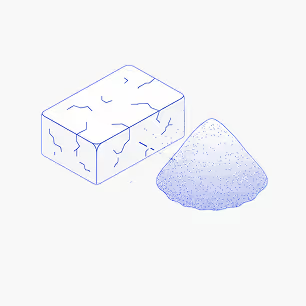
Crushing and classification are sequenced to achieve defined, repeatable PSD ranges.

Batch-level verification

Each lot is tested for chemistry and particle characteristics before dispatch.
Isometric illustration of a stack of stone bricks with visible cracks and texture.

Built for industrial systems where stability is non-negotiable

We work with engineers, procurement teams, process operators, and long-term capital partners in industries where operational reliability defines value.
Arrow pointing to the right
Discuss your application

FAQs

If you have questions about limestone products, specifications, or typical applications, the answers below address some of the most common topics. For anything more specific, our technical team is happy to help.

Arrow pointing to the right
Contact us

What is Lime?

Lime is a broad mineral term for naturally occurring calcium carbonate formations — Limestone, Chalk and Dolomite Chemical Grade and High-Grade Limestone offer exceptional purity levels, making it the preferred raw material for demanding industrial and chemical processing applications. In precise industrial application, Lime defines a refined family of high-purity mineral products — including Quicklime, Dolime, Hydrated Lime and Precipitated Calcium Carbonate (PCC).

What is the Lime Cycle and how does it produce Quicklime, Hydrated Lime and PCC?

The Lime Cycle is one of the oldest known chemical reactions in human history — a three-stage mineral transformation of extraordinary industrial precision. Calcination fires Limestone (CaCO₃) in a kiln beyond 900°C, expelling CO₂ to produce Quicklime (CaO). Hydration introduces water to Quicklime, yielding Hydrated Lime Ca(OH)₂. Finally, Carbonation — reintroducing CO₂ under controlled conditions — produces Precipitated Calcium Carbonate (PCC), completing the cycle with a mineral of exceptional purity.

Why is Lime considered essential yet largely unseen in everyday life?

Lime is the world's most quietly indispensable mineral. The glass in your window, the paper you write on, the cosmetics on your shelf, the sugar in your tea — all carry the invisible contribution of Lime. Its properties of alkalinity, purification and neutralisation make it a silent ingredient across the products. Lime is equally irreplaceable across construction, manufacturing, water treatment and agriculture. Uniquely, it is the only mineral capable of contributing to both Steel and Sugar production on the same day — a presence so fundamental, yet so rarely seen.

Why is Lime the most sustainable and cost-effective alkaline product for industrial purification?

Lime is not simply a cost-effective alkaline option — it is the most complete one. Abundant in nature, proven across millennia and effective across every stage of the purification cycle, it remains the benchmark against which all industrial alkaline products are measured.

Extended material portfolio

From limestone to quicklime, hydrated lime, and PCC.
in the pipeline
Illustration of four hot lime stones emitting steam above a small flame on a reddish background.
Engineering phase, 2027

Quicklime products

High-reactivity quicklime manufactured in Maerz kilns for controlled calcination and consistent performance
Coming soon
Illustration of fluid flowing smoothly in a cylindrical pipe with white streamlines and arrows indicating flow direction on a blue gradient background.
development Phase

Hydrated lime products

Hydrated lime engineered for treatment, environmental control, and chemical processing systems
Coming soon
Abstract geometric shape of a lime stone with white contour lines and arrows on a gradient teal background.
Design phase

PCC

Precipitated calcium carbonate engineered for specialty performance and controlled particle systems.
Coming soon