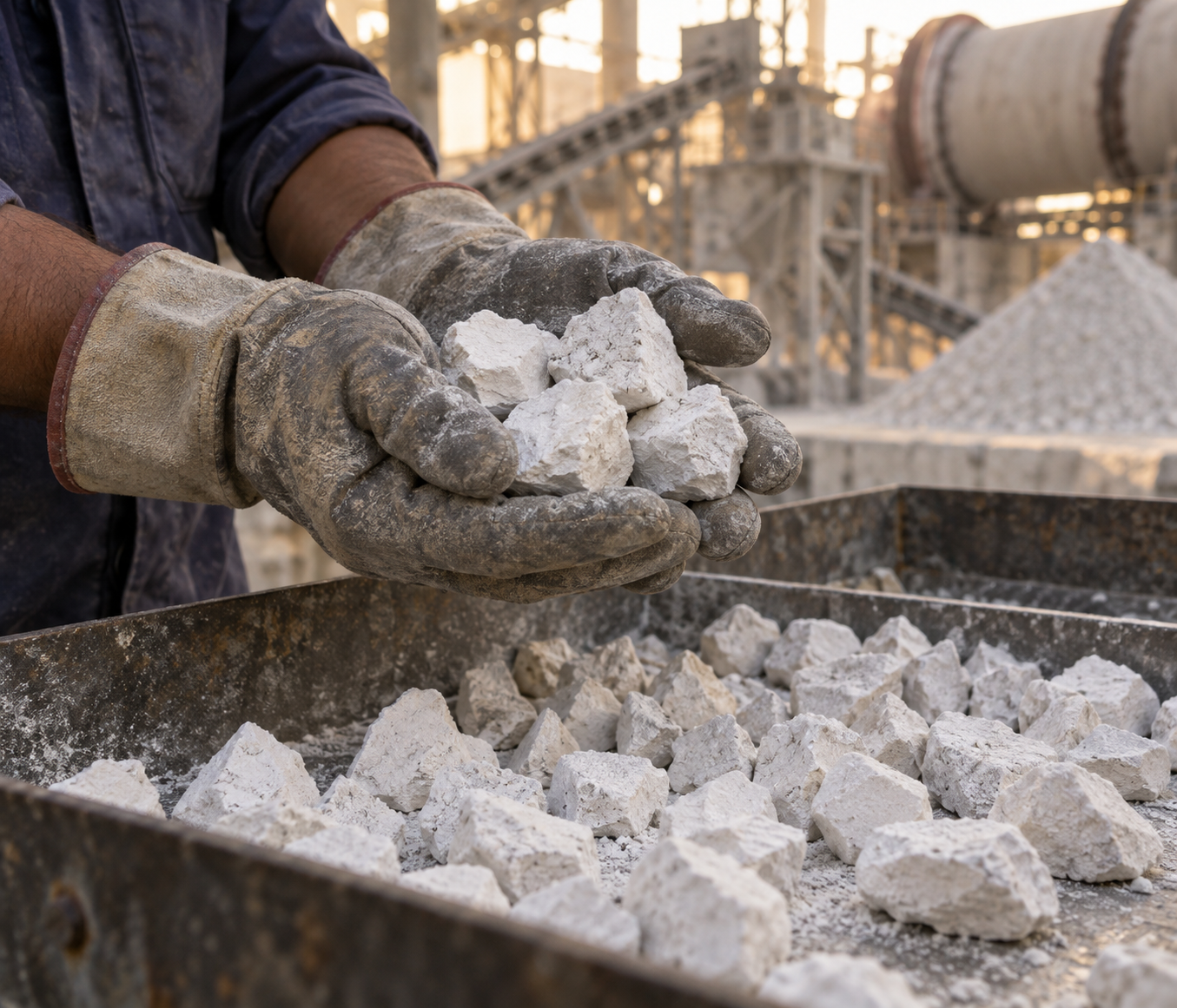





High-Purity Limestone Supplier in India: Key Specifications Buyers Should Check

A limestone can meet a headline purity figure and still fail in the plant. This guide explains the chemical and physical specifications buyers should check before approving a high-purity limestone supplier in India, from guaranteed CaCO3 minimums and impurity limits to test report verification and batch consistency.
Choosing a high-purity limestone supplier in India takes more than comparing CaCO3 percentages. A material can meet a headline purity figure and still fail in the plant if the impurities behind that number are not suited to the process.
Before approving a high-purity limestone supplier in India, buyers should check the guaranteed CaCO3 or CaO content, the maximum limits for MgO, SiO2, Fe2O3, and Al2O3, particle size and moisture content, batch-level test reports, and whether the supplier can consistently meet those specifications across commercial volumes.
This guide explains what each of those specifications means, how to read a supplier's numbers, and how to verify purity claims before committing to regular supply.
What does "high-purity limestone" actually mean?
High-purity limestone and high-quality limestone are often used interchangeably in the industry.
When someone refers to high-purity limestone, what they mean is a limestone that contains a high proportion of calcium carbonate (CaCO3) with controlled levels of unwanted minerals. But there is no single purity percentage that makes limestone suitable for every application.
Limestone is a natural material. Along with calcium carbonate, it may contain magnesium compounds, silica, iron oxide, alumina, clay, sulphur, phosphorus, and other trace elements. The acceptable level of each depends on how the limestone will be used. Low iron is critical for solar glass. Low magnesium may matter more in poultry feed and certain chemical processes. FGD systems care about reactivity as much as they do about purity.
This is why terms like high-purity limestone, high-calcium limestone, and chemical-grade limestone are not interchangeable. A buyer should define high purity in terms of the process's needs, not a single market-wide percentage.
Key terms buyers should understand
- CaCO3 content: The percentage of calcium carbonate in the raw limestone.
- CaO equivalent: The theoretical calcium oxide the limestone can produce after complete calcination. It is not the same as free CaO in raw limestone.
- High-calcium limestone: Limestone dominated by calcium carbonate with relatively low magnesium.
- Chemical-grade limestone: Limestone that meets defined chemical limits for a specific industrial process.
- Application grade: A grade built around the full requirements of one process: chemistry, sizing, reactivity, and consistency together.
How to evaluate CaCO3 content
CaCO3 is usually the first number buyers look at. In general, a higher percentage means less non-carbonate material and a stronger starting point for industrial use. But the number has to be read carefully.
These ranges are broad procurement guidance, not universal acceptance limits. A 96% CaCO3 limestone may outperform a 98% CaCO3 limestone if its impurity profile and physical properties better fit the process.
Three questions turn this number into something useful:
- Is the value typical or guaranteed? A high typical value still allows weaker batches unless a minimum is agreed in writing.
- How was the sample collected? A mine-face sample, a lab sample, and a dispatch-lot sample can give different results. The certificate should say which one was tested.
- How consistent is the result over time? One strong report does not prove the quality of the supply. Review results across multiple dispatch batches before approving a supplier.
CaCO3 is the starting point of the evaluation, not the decision. The next step is understanding what makes up the remaining percentage.
Why CaCO3 percentage alone is not enough
Two limestone samples can both contain 97% CaCO3 and still behave completely differently in a plant. One may carry higher iron, making it unsuitable for clear or solar glass. The other may carry more silica or magnesium, affecting raw-mix balance, slag chemistry, or chemical processing.
The non-CaCO3 fraction can include magnesium compounds, silica, iron oxide, alumina, clay and insoluble matter, sulphur, phosphorus, and other trace elements. Which of these matters most depends entirely on the application. That is why the impurity limits deserve as much attention as the purity figure.
Key chemical specifications buyers should check
Calcium oxide (CaO)
CaO expresses the calcium value of limestone after calcination and is most relevant in cement, lime manufacturing, steelmaking, and chemical processing. In raw limestone, it is reported as an oxide equivalent, not as free quicklime.
Magnesium oxide (MgO)
MgO separates high-calcium limestone from dolomitic material. Some processes tolerate magnesium; others need tight control. Low-MgO limestone is most important in poultry and animal feed, glass manufacturing, chemical-grade applications, and cement plants that manage clinker chemistry. Buyers should check the stated MgO limit and the permitted range, not just a typical value.
Silica (SiO2)
Silica is one of the most closely watched impurities in industrial limestone. Higher silica affects glass batch chemistry, raw-mix calculations, slag formation, and chemical purity. In some chemical applications, buyers specify total insoluble matter rather than relying on SiO2 alone.
Iron oxide (Fe2O3)
Iron content is the critical parameter in glass. Even small variations affect colour, clarity, and light transmittance, and solar glass specifications often set iron limits in parts per million rather than percentages. Float glass, solar glass, and filler applications need much tighter iron control than cement or construction uses.
Alumina (Al2O3)
Alumina is usually present in small amounts but still influences clinker chemistry, slag behaviour, and chemical-process suitability. It is often missing from basic supplier sheets, so buyers should confirm it appears on the certificate of analysis.
LOI, phosphorus, sulphur, and trace elements
Loss on ignition (LOI) refers to the volatile fraction released during heating, primarily CO2 from carbonate decomposition. Phosphorus and sulphur can be critical in steel, feed, and chemical applications. A standard oxide analysis does not cover every risk, so buyers should specify any additional trace elements their application requires testing for, especially where the limestone comes into contact with food, feed, or water treatment.
Physical specifications buyers should not overlook
Chemistry tells you what the limestone contains. Physical properties decide how it behaves in the plant.
Particle size and distribution. Look beyond the average size. Check the full distribution: oversized particles, fines percentage, and the permitted range. Kilns may need controlled lumps, while FGD, fillers, chemicals, and feed applications need defined powders, granules, or grit. Consistent sizing across dispatches matters as much as the size itself.
Moisture. Excess moisture increases freight cost, reduces flowability, affects dosing accuracy, and causes caking in fine material. Agree a maximum moisture limit in writing rather than accepting a general "dry material" description.
Reactivity: purity does not always predict performance
Two samples with similar CaCO3 levels can react at different rates because of differences in mineral structure, porosity, hardness, and particle size. Reactivity matters most where limestone must dissolve, neutralise, calcine, or react within a controlled time.
In FGD systems, slower-reacting limestone can reduce sulphur dioxide removal efficiency or increase limestone consumption. In chemical processing and water treatment, reaction rate affects dosing and process stability. When limestone is ground on-site, grindability also affects milling energy and throughput.
Depending on the application, buyers may ask for acid reactivity, dissolution rate, neutralising value, grindability, or slurry performance tests. A purity certificate confirms composition. It does not show how the material performs under operating conditions. For sensitive processes, a plant trial answers what paperwork cannot.
Limestone specifications vary by industry
There is no single specification that works across every industrial use. Prioritise the parameters that drive your own process:
Final specifications should always be confirmed by the buyer's technical or quality team.
Typical values vs guaranteed specifications
Supplier data sheets often present chemistry as typical values. These are useful for screening, but they do not define what the supplier will deliver in every batch. For procurement, the distinction matters.
A supplier may report CaCO3 at 97% as a typical value while the guaranteed minimum is lower. For long-term supply, the purchase specification should clearly distinguish between typical values and guaranteed minimums, maximums, and permitted ranges. That removes ambiguity when a batch is tested before or after delivery.
How to verify a limestone supplier's test report
A certificate of analysis is only useful when you know what was tested, how the sample was collected, and whether it represents the material you will actually receive. Six checks cover it:
- Confirm the batch identity. The report should name the specific batch, lot, or dispatch it represents. A generic lab report without traceable references has limited procurement value.
- Check the date and the laboratory. Recent results matter more than old ones. Know whether testing was in-house, independent, or a mix of both.
- Review the test method. XRF for oxides, sieve or laser analysis for particle size, moisture and LOI testing, and application-specific reactivity tests each answer different questions. The method should match the parameter.
- Check whether the sample is representative. A hand-picked sample does not reflect commercial supply. Ask whether it came from a single mine point, a production batch, a dispatch lot, or a composite collected over time.
- Compare more than one batch. One certificate shows one result. Several recent batches show how CaCO3, MgO, SiO2, Fe2O3, moisture, and sizing vary over time. A stable specification is worth more than one exceptional result.
- Run independent testing where the process is sensitive. For critical applications, verify results through an independent laboratory, or run a plant trial where performance depends on reactivity, grindability, or feeding behaviour.
The goal is not more paperwork. It is making sure the report reflects the material that will actually reach the plant.
Consistency depends on the supplier's systems, not just their lab
Limestone chemistry varies across a deposit, and processing introduces additional variation through crushing, screening, blending, and storage. A supplier can meet the specification once and still fail to hold it across repeated deliveries.
Whether a supplier can hold a specification usually comes down to how much of the chain they control: the source itself, processing, blending, and segregated storage, representative sampling before dispatch, and lot traceability, so every delivery links back to a quality-control batch. Suppliers that control their own sourcing and run their own beneficiation have far more room to manage natural variation than suppliers that pass along third-party material.
We covered that evaluation in detail in our guide on how to evaluate a limestone supplier in India. For this article, the purity-specific question is simple: ask for historical batch data, and ask what happens when a batch falls outside the agreed specification. The answers indicate whether the purity claim applies to a system or a sample.
Questions to ask a high-purity limestone supplier before ordering
These questions move the conversation from a brochure comparison to a specification-based evaluation.
How Dr. Lime approaches high-purity limestone supply
Dr. Lime treats limestone as an engineered industrial material, not an undifferentiated mineral, and its quality model maps directly onto the checks in this article.
Dr. Lime controls quality from the extraction stage. Its material comes from a controlled, single-source deposit with up to 96% calcium carbonate content, selectively extracted and pre-classified at the mine site. In-house processing then holds the specification: optical sorting removes off-grade fractions, precision milling and screening define particle size windows, and multi-stage magnetic separation brings iron down to the low levels demanded by glass and solar glass applications.
Every batch is tested for chemistry and particle characteristics before dispatch, and each of Dr. Lime's engineered limestone products ships with a Certificate of Analysis and MSDS, so buyers can verify exactly what they receive against what was agreed. For purity-critical applications, this includes grades like low-iron limestone for solar glass. The company operates under ISO 9001, ISO 14001, ISO 45001, and ISO 50001 systems and supplies industrial buyers across glass, solar glass, FGD, poultry and animal feed, chemicals, cement, fillers, and agriculture from Rajasthan's limestone belt.
Evaluating a specific requirement? Share your target CaCO3 or CaO level, impurity limits, particle size, monthly volume, and delivery location, and the Dr. Lime team can help assess the right limestone specification for your application.
Conclusion
Choosing a high-purity limestone supplier in India starts with defining the specification your process actually needs. CaCO3 matters, but so do the impurity limits, sizing, reactivity, and the supplier's ability to hold those parameters at commercial scale.
The strongest supplier is not the one with the highest purity claim. It is the one that can guarantee the required grade in writing, prove it batch by batch, and supply it consistently.
FAQs
What CaCO3 percentage is considered high-purity limestone?
There is no single universal threshold, but limestone with around 95% CaCO3 or higher is often considered high purity for many industrial applications. Final suitability still depends on impurity levels, particle size, reactivity, and the requirements of the specific process.
Can a high-purity limestone supplier customise specifications for different industries?
Yes, capable suppliers develop application-specific grades rather than selling one generic material. Chemistry limits, particle size, impurity control, and testing requirements differ by process, so buyers should confirm the supplier can meet the tighter limits their application needs, not just a standard product sheet.
What is the difference between high-purity and high-calcium limestone?
High-purity limestone broadly refers to limestone with a high proportion of calcium carbonate and controlled impurities. High-calcium limestone specifically refers to limestone with high calcium and relatively low magnesium content. The terms overlap, but they are not interchangeable.
Which impurities should buyers check in limestone?
The most common parameters are MgO, SiO2, Fe2O3, Al2O3, phosphorus, sulphur, moisture, and application-specific trace elements. Which limits matter most depends on the end use: iron for glass, magnesium for feed and chemical uses, silica for glass and cement.
Why is low-MgO limestone important?
Low MgO matters where excess magnesium affects process chemistry, product quality, or formulation. This applies to poultry feed, glass manufacturing, chemical-grade applications, and cement plants managing clinker chemistry. The acceptable limit should be defined by the buyer's process.
What limestone specifications matter for glass manufacturing?
Glass manufacturers focus on high CaCO3 with tightly controlled Fe2O3, SiO2, and MgO, plus defined particle size. Low iron is especially important for clear, float, and solar glass, because even small amounts of iron affect colour and light transmission.
What specifications matter for FGD limestone?
FGD buyers evaluate CaCO3 content, reactivity, grindability, particle size distribution, MgO, and moisture. A high purity figure alone does not guarantee good sulphur dioxide removal, because reaction rate depends on the stone's structure and fineness as well as its chemistry.
How can buyers verify the purity of limestone before purchase?
Review recent batch-level certificates of analysis, confirm the sampling and test methods used, and compare results across multiple batches. Use independent laboratory testing where the process is sensitive, and run a plant trial where performance depends on reactivity or handling behaviour.
Should a limestone supplier provide a certificate of analysis with every dispatch?
For process-critical applications, yes. Dispatch-linked or lot-linked certificates of analysis let the buyer trace the received material back to a specific quality-control batch, which makes any variation easier to investigate and resolve.
What documents should buyers request from a limestone supplier?
Buyers should ask for a specification sheet with guaranteed chemical and physical limits, recent certificates of analysis from multiple dispatch batches, details of the test methods used, and quality system certifications. For size-sensitive or process-sensitive applications, add particle-size distribution data and trial results. The point is to verify commitments against regular commercial supply, not a single brochure.