



Why India’s Growing Glass Industry Needs Higher-Purity Limestone

India's glass demand is being pulled upward by real estate, automotive, pharma, and solar. But the country still imports the solar glass it cannot make cleanly, and the reason starts before the furnace. This article explains what limestone does in glass manufacturing, why iron content decides which markets a glass plant can serve, and why having limestone is not the same as having glass-grade limestone.
Ask anyone in Indian manufacturing where the glass industry's bottleneck sits, and you will hear the same answer: furnaces. Building a float line is slow, expensive, and energy-hungry, and India has not built enough of them. All of that is true.
It is also not where the story starts.
India uses less than 2 kg of glass per capita each year, while developed markets run into double digits. Real estate, automotive, pharma, and solar are all working to close that gap simultaneously. But growth in glass manufacturing in India depends as much on raw material quality as on furnace capacity. Limestone supplies the calcium that stabilises the glass melt, and its iron content sets a hard ceiling on how clear the finished glass can be. Below a certain purity, the glass cannot meet solar or optical specifications, no matter how good the furnace is.
Everyone is watching the furnaces. The more interesting problem starts one step earlier, and this article is about that step.
Four engines, one direction
Glass demand does not rise on its own. It rises because the industries that consume glass are growing, and in India, four of them are growing at once.
Real estate and construction are the broadest of the four. Commercial buildings, data centers, airports, metro stations, and urban housing all consume flat glass, and energy-efficiency codes are pushing the market from basic float glass toward laminated, insulated, and coated products. That raises the quality bar along with the volume. Automotive adds windscreens, glazing, and the increasingly large panoramic roofs that electric vehicles have made standard. Pharmaceutical packaging turns container glass into a strategic material, because India's position in global generics depends on packaging that is inert, consistent, and defect-free.
And then there is solar, the fastest and hungriest of the four. Every gigawatt of module capacity consumes thousands of tonnes of glass, and the industry's shift toward glass-glass module designs roughly doubles the glass used per panel.
Look at the right-hand column, and a pattern appears. Each engine demands not just more glass, but better glass. And the most demanding of them, solar, wants a grade that most Indian plants cannot currently make.
The import paradox
India is racing to build solar manufacturing capacity to stop relying on imports. To do it, the country imports solar glass, mostly from China and Malaysia, because domestic production covers only a minority of demand. Anti-dumping duties were introduced to protect local glassmakers, and the gap still has not closed.
That is a strange position to be in, and the usual explanation is capacity: build more solar-grade float lines and the problem solves itself.
Except a furnace does not make glass clear. It inherits the purity of whatever it is fed. A brand-new float line fed with high-iron raw material will produce tinted glass on day one and keep producing it for the life of the campaign. Import substitution in glass is treated as a capital expenditure problem, but part of it is a raw material problem, and that part starts in the ground.
Which raises the obvious question: what does a glass furnace actually get fed?
Inside the batch
Most people assume glass is made from sand, and sand is indeed the largest input. But it is not the one that decides quality.
Soda-lime glass, which covers most flat and container glass, is made from silica sand, soda ash, and limestone or dolomite. The limestone carries the calcium, and calcium does the structural work. It locks into the silica network and gives the finished glass its strength, its resistance to weathering, and its chemical durability. It also controls how the melt flows, which helps keep a furnace stable.
Stability matters more here than in almost any other industry, because a glass furnace runs continuously, often for years, without shutting down. There is no reset between batches. If the calcium input drifts, the furnace does not produce one bad lot. It develops a slow-moving problem inside a system that cannot be stopped and corrected.
So the limestone has to be consistent. But hidden within the limestone is a single impurity that determines which markets the glass can be sold into at all: iron.
Iron oxide, Fe2O3, is a colorant. Whatever iron enters the furnace passes straight into the finished glass, where it absorbs light and adds a green tint. In a window, that tint is cosmetic. In solar glass, it is a disqualification, because a solar module earns its keep by letting light through to the cell, and glass that absorbs light cuts the module's output for every one of its twenty-plus operating years. This is why iron in glass-grade limestone is specified in parts per million. At the levels that matter, percentages are too coarse to be useful.
And there is no undo. No downstream step pulls iron back out of a melt. The purity has to be right when the material enters the furnace, which means it has to be right when it leaves the supplier.
The problem, in other words, has to be solved at the source. That is where India's real constraint shows up.
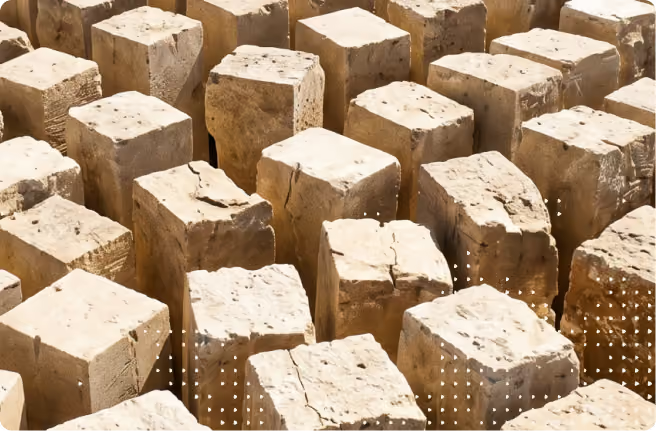
India has limestone, but barely has high-purity limestone.
India is one of the world's major limestone producers, with deposits across many states feeding cement, steel, chemicals, agriculture, and construction.
Availability, though, is not suitability.
Most Indian limestone is perfectly good for cement, and cement is forgiving: it tolerates iron and silica and accepts grades a glass plant would reject at the gate. The supply chains were built to serve that buyer, because that is where the volume has always been.
Glass-grade limestone is a much narrower subset: high and consistent calcium, low silica, controlled magnesium, and iron held down in the ppm range. Solar-grade is narrower still. So the question facing an Indian glass manufacturer is not whether limestone is available. It is whether limestone of this purity can be supplied consistently and in commercial volume throughout the years a furnace campaign runs. Far fewer suppliers can answer that question, and it is the honest reason the gap between India having limestone and India making its own solar glass has stayed open.
What would closing it look like?
What "solved" looks like
Here is the thing about a glass-grade limestone supply chain: most of what it has to deliver is not chemistry. It is control. The specification sheet tells you what the supplier promises. Control is what determines whether the promise survives two years of continuous dispatches.
Read the table below with that lens:
Final specifications should always be confirmed by the buyer's technical or quality team.
Only the first three rows are about the rock. The rest are about the supplier: whether it can select the right material at the source, process out what does not belong, and prove the result batch after batch. That is the standard, and it is the standard Dr. Lime was built against.
Where Dr. Lime fits in India's glass supply chain
Dr. Lime controls quality from the extraction stage. Its material comes from a controlled, single-source deposit with up to 96% calcium carbonate content, selectively extracted and pre-classified at the mine site, so consistency is managed before processing rather than corrected afterward. In-house beneficiation then meets the specification: optical sorting removes off-grade fractions, precision milling and screening define particle-size windows, and multi-stage magnetic separation strips out iron-bearing impurities.
That last step deserves a pause, because it is the direct answer to the iron problem. Low iron in the finished product is not a geological accident Dr. Lime happened upon. It is a processing capability deliberately applied for exactly the applications this article has been describing.
The result is glass-specific grades rather than one general product. Solaris Pure is built for solar and optical glass, with Fe2O3 held at 300 ppm or below, CaO at 54% or above, SiO2 at 0.1% or below, and MgO at 0.8% or below, supplied in size ranges from 0.1 mm to 2.0 mm with custom PSD available. Glass Pure serves batch stability and optical consistency in float glass, and Base Pure covers standard and specialty glass melting.
Every lot is tested for chemistry and particle distribution before dispatch, and each product includes a downloadable Certificate of Analysis and safety data sheet, so a glass plant's quality team can verify the material against its own specification rather than take anyone's word for it. Dr. Lime operates under ISO 9001, ISO 14001, ISO 45001, and ISO 50001 systems and supplies lime materials for float, solar, and specialty glass from Rajasthan's limestone belt.
The furnace is only half the story
India's glass demand is not in question. Real estate, automotive, pharma, and solar are pulling in the same direction, and per-capita consumption has years of climbing left to do.
The question this article opened with is the one worth ending on. India will make far more glass. Whether it makes the good glass, the solar-grade and optical-grade glass it currently imports, will be decided partly at the furnaces everyone is watching, and partly at a limestone source most people never think about.
A solar glass line cannot outperform the limestone it uses.
If you are evaluating limestone for float, solar, or specialty glass production, Dr. Lime can help you assess the right grade, iron limits, and particle size for your batch chemistry.
FAQs
What is limestone used for in glass manufacturing?
Limestone is the primary calcium source in soda-lime glass. The calcium oxide it supplies stabilises the silica network, which gives glass its mechanical strength and chemical durability, and it controls melt viscosity during furnace processing. Limestone quality directly affects both glass performance and furnace stability.
Why is low-iron limestone important for glass?
Iron oxide acts as a colorant. Any iron entering the furnace through the raw materials carries into the finished glass, where it absorbs light and adds a green tint. For clear, float, and especially solar glass, iron content must be tightly controlled because it cannot be removed once the glass is made.
What Fe2O3 level is needed for solar glass?
Solar glass requires iron control measured in parts per million rather than as percentages, because even trace amounts of iron reduce light transmittance and lower module output. Exact limits depend on the manufacturer's specification, but ppm-level Fe2O3 in the feed limestone is an entry requirement for solar-grade supply, not a preference.
Why is India's per capita glass consumption so low?
India's per-capita glass consumption sits below 2 kg per year, well under levels in developed markets. The main reasons are historical: lower construction intensity, less processed-food packaging, and cost-driven substitution toward plastic. As construction standards, automotive production, pharma packaging, and solar all expand, consumption is expected to rise.
Does India import solar glass?
Yes. India remains dependent on imported high-transparency solar glass, with domestic production covering only part of total demand and the balance sourced mainly from China and Malaysia. Anti-dumping duties have been introduced to support domestic manufacturers, and local capacity is expanding, but the supply gap has not closed.
What limestone specifications matter for float glass plants?
Float glass plants evaluate calcium content, iron oxide, silica, magnesium, particle size distribution, and batch-to-batch consistency. Because float furnaces run continuously for years, stability of the feed material matters as much as any single specification value.
Does Dr. Lime supply limestone for glass manufacturing?
Yes. Dr. Lime supplies application-specific limestone grades for float, solar, and specialty glass, including Solaris Pure for solar and optical glass with Fe2O3 held at 300 ppm or below. Material is drawn from a single-source deposit and processed in-house through optical sorting and magnetic separation to control iron, with a Certificate of Analysis available for each product.