



The Limestone in Your Solar Panel: The Layer of India’s Clean Energy Supply Chain Nobody Tracks

Since June 2026, Indian solar projects must use domestically made cells. Wafers follow in 2028, and solar glass is being pushed home through duties and new capacity. But every layer India localises exposes the next one down, and at the bottom of the ladder sits a mineral no policy document names: the low-iron limestone solar glass cannot be made without.
Since June 1, 2026, every government-backed, net-metered, and open-access solar project commissioned in India must use domestically manufactured solar cells. Modules were already covered. Ingots and wafers get their turn in June 2028. Layer by layer, India is pulling its solar supply chain home.
But solar localization works like a ladder. Every layer India localises solves one dependency and exposes the next one down. Modules expose cells. Cells expose wafers. Wafers expose glass. And underneath the glass sits the layer no policy document has ever named: the minerals, including the low-iron limestone that solar glass cannot be made without.
This article traces a solar panel all the way down that ladder, to the layer nobody tracks.
The localisation ladder
India's solar manufacturing policy has followed one consistent logic for years: start at the finished product and work backward.
Each rung follows the same pattern. A mandate creates demand, domestic capacity scrambles to meet it, and the scramble reveals that the layer below was imported all along. Cell makers discovered this in June, when module capacity exceeded 200 GW, while approved domestic cell capacity was roughly 30 GW.
The pattern will keep repeating until the ladder reaches the ground. So it is worth asking early: what is actually at the bottom?
A solar panel is mostly glass, and glass starts in the ground
Strip a solar module down to its bill of materials and the largest single component by weight is not silicon. It is glass. In the glass-glass designs the industry is moving toward, glass sits on both faces of the panel and dominates the module's mass.
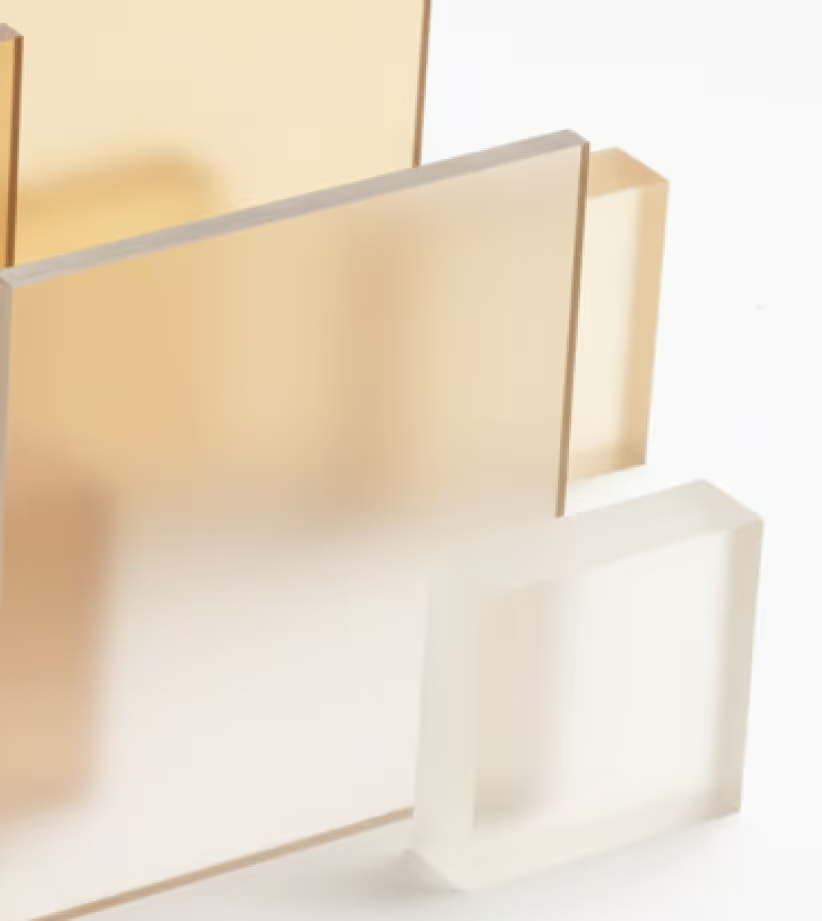
That glass is a specialised product. Solar glass must transmit as much light as possible for twenty-five years or more, which is why it is made to far tighter standards than window glass. Its recipe, though, is old and simple: silica sand, soda ash, and limestone.
India's solar glass industry has been fighting for this layer of the ladder for two years. After imports from China and Vietnam surged to several times domestic capacity, anti-dumping duties were imposed in late 2024. Six domestic manufacturers now produce around 2,300 tonnes per day, and the largest of them is investing ₹950 crore to expand its output by 60%. The industry association representing glass and other ancillary makers has asked for an ALMM-style domestic content mandate of its own.
The industry's core argument for self-reliance is that India already has everything it needs: a skilled workforce, capital, land, and raw materials.
At the headline level, that is true. India is one of the world's largest producers of limestone, and its silica sand resources are substantial. But there is a caveat hidden in the words "raw material," and it is the same caveat that determines whether a glass furnace can serve the solar market at all.
The caveat is purity
Solar glass lives or dies by its iron content. Iron in the raw materials passes into the finished glass, absorbs light, and permanently reduces the amount that reaches the solar cell. For a product whose entire job is transmitting light, iron is a disqualifying impurity, which is why it is specified in parts per million rather than percentages. And there is no fixing it later: no downstream process removes iron from a melt.
So when a glass manufacturer says India has the raw material, the precise question is whether India has enough limestone with ppm-level iron that can be consistently delivered at the furnace scale. Most Indian limestone was never meant to answer that question. It serves cement, steel, and construction, where iron barely matters. Glass-grade limestone is a narrow subset of the country's reserves, and solar-grade is narrower still.
We covered that argument in full in why India's growing glass industry needs higher-purity limestone. For this article, the short version is enough: the bottom rung of India's solar ladder is not just a mineral. It is a mineral at a specification.
Which raises an uncomfortable thought. If limestone purity can gate solar glass, and solar glass can gate the panel, why does limestone appear on no one's list of clean energy materials?
The critical mineral that isn't on the list
India's critical minerals conversation runs to lithium, cobalt, nickel, rare earths, and polysilicon. Those deserve attention. They are scarce, contested, and concentrated in a handful of countries.
Limestone will never make that list, and in one sense it shouldn't. It is not scarce. It is one of the most abundant industrial rocks on earth, and India mines enormous quantities of it every year.
But abundance is measured in tonnes, and solar glass does not buy tonnes. It buys a specification. Judged at ppm-level iron with consistent chemistry across years of continuous furnace operation, the abundant mineral becomes a scarce one. A deposit either has low iron mineralogy, or it does not. A supplier either has the beneficiation capability to remove iron-bearing impurities, or it does not. Neither can be improvised when a new float line comes online and needs qualified feedstock from day one.
This is the quiet risk in the glass layer of India's solar ladder. Domestic glass capacity is expanding by design, through duties, investment, and possibly a mandate. Every new furnace that lights up converts policy into physical demand for solar-grade limestone. If the qualified supply is not ready when the furnaces are, the import dependency does not disappear. It just moves one layer down, from glass to the minerals inside it.
The way to prevent that is to build the bottom rung before it is needed. In Rajasthan, it already is.
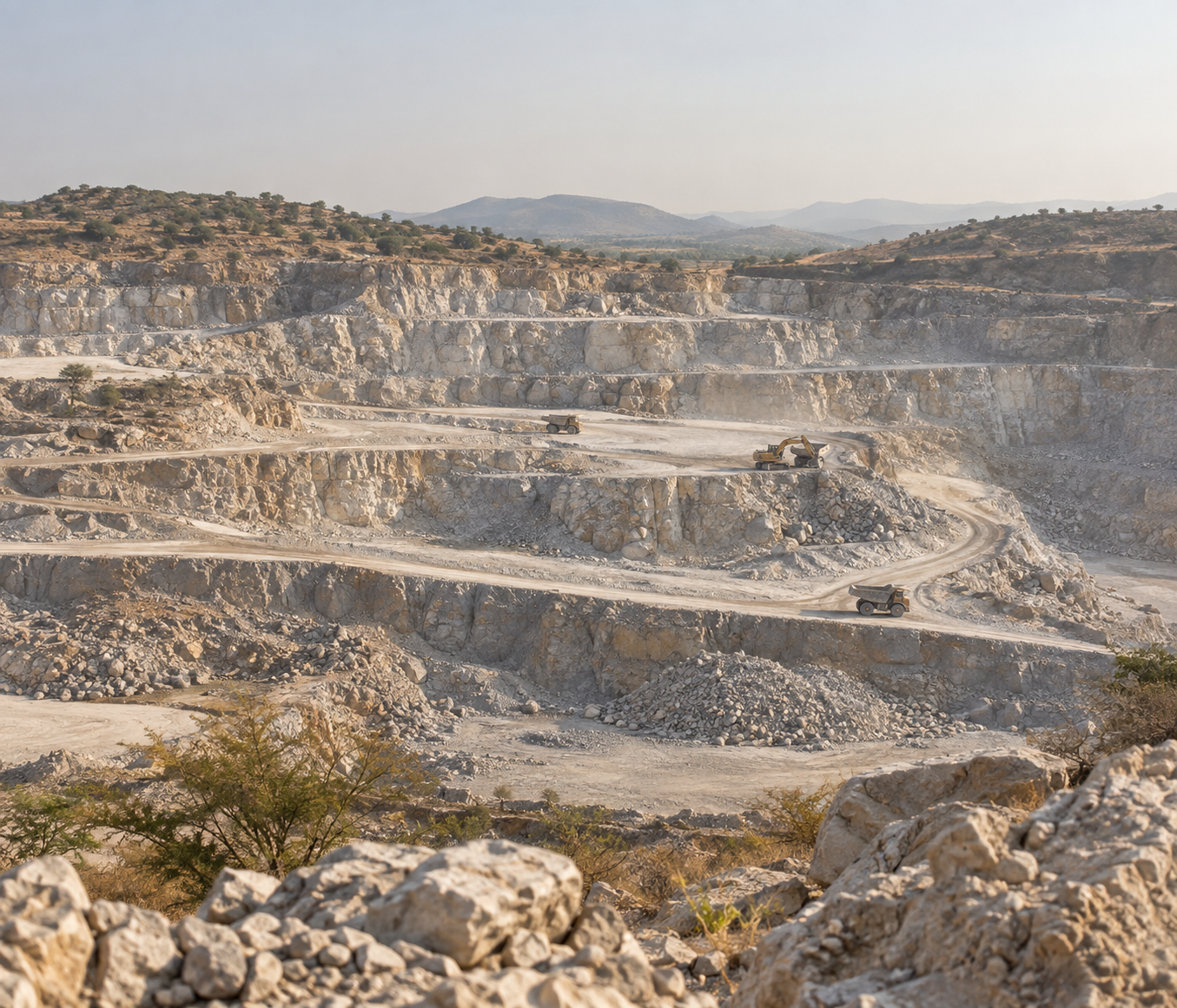
The bottom of the ladder already exists in Rajasthan
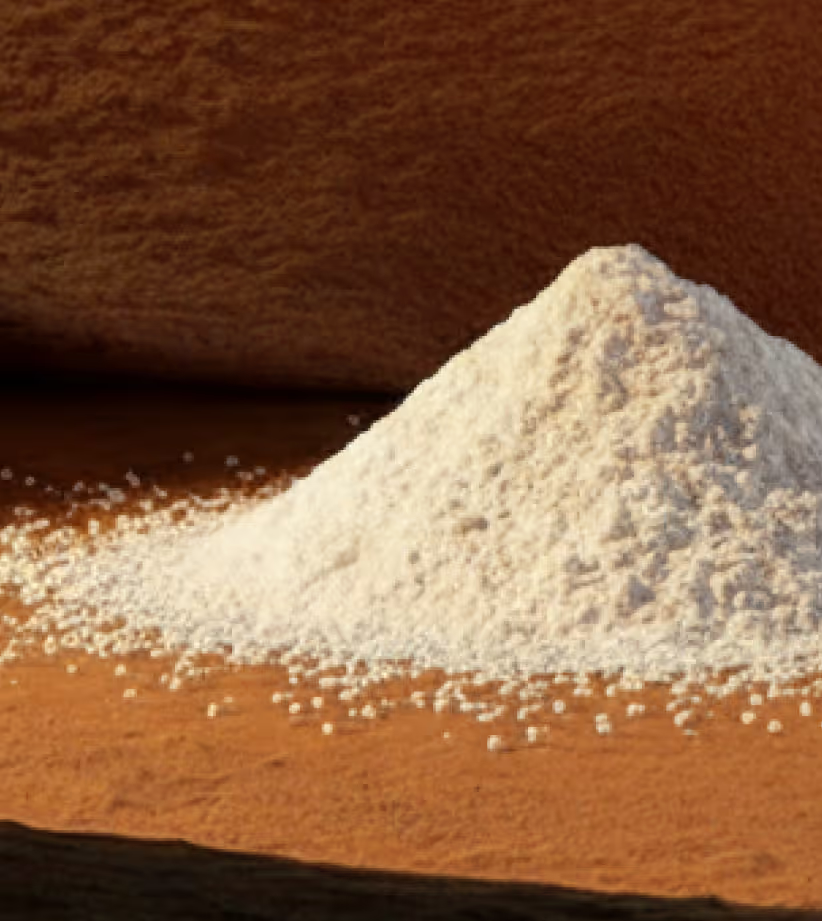
Dr. Lime controls quality from the extraction stage. Its material comes from a controlled, single-source deposit with up to 96% calcium carbonate content, selectively extracted and pre-classified at the mine site. In-house beneficiation then does the work that solar glass demands: optical sorting removes off-grade fractions, precision milling and screening maintain defined particle-size windows, and multi-stage magnetic separation strips out iron-bearing impurities.
That processing chain exists for exactly one reason: to produce limestone to specifications that most deposits and most suppliers cannot meet.
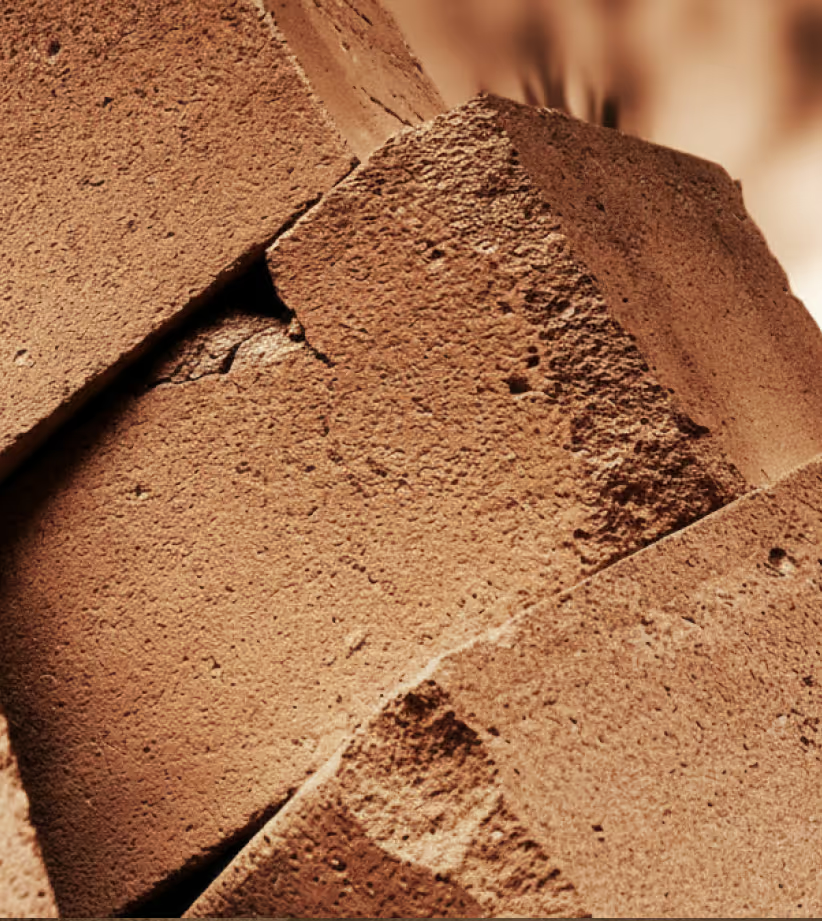
Solaris Pure is the solar-grade result, with Fe2O3 held at 300 ppm or below, CaO at 54% or above, SiO2 at 0.1% or below, and MgO at 0.8% or below, in controlled size ranges with custom PSD available. Every lot is tested before dispatch and ships with a Certificate of Analysis, so a glass plant's quality team can qualify the material against its own specification. Dr. Lime operates under ISO 9001, ISO 14001, ISO 45001, and ISO 50001 systems and supplies lime materials for float, solar, and specialty glass from Rajasthan's limestone belt.
For India's expanding solar glass industry, that means the last layer of the localisation ladder does not have to be discovered in a hurry. It is already qualified, documented, and in production.
How deep does Make in India go?
Trace a solar panel commissioned in India this year all the way down. The module is Indian. As of June, the cells inside it must be Indian. The wafers will follow in 2028. The glass is on its way, furnace by furnace.
And beneath the glass, at the very bottom of the ladder, is a rock, selected, sorted, and iron-stripped to a specification measured in parts per million, from a deposit in Rajasthan.
India's clean energy supply chain goes as deep as its mineral supply. The countries that win localisation are the ones that build the bottom rungs before the top ones need them.
If you are planning to expand or are already producing solar glass and want to evaluate domestic limestone for solar-grade specifications, Dr. Lime can help you determine the right grade, iron limits, and particle size for your batch chemistry.
FAQs
What raw materials go into a solar panel?
A solar panel's main materials are glass, silicon cells, encapsulant films, a backsheet or second glass layer, an aluminum frame, copper wiring, and a junction box. By weight, glass is the largest component, and that glass is made primarily from silica sand, soda ash, and limestone.
What is solar glass made of?
Solar glass is a low-iron soda-lime glass made from silica sand, soda ash, and limestone or dolomite. It differs from ordinary glass mainly in purity: the iron content in the raw materials must be extremely low because iron absorbs light and reduces the solar module's power output.
Why does solar glass need low-iron limestone?
Iron entering the furnace with raw materials passes into the finished glass, permanently reducing light transmittance. Since a solar module's output depends on light reaching the cell, solar glass manufacturers specify iron in the feed limestone in parts per million. Iron cannot be removed from the glass after it has melted.
Does India manufacture its own solar glass?
Partly. India has six domestic solar glass manufacturers with combined capacity of roughly 2,300 tonnes per day, and capacity is expanding. But demand from India's growing module industry still exceeds domestic supply, so imports continue, mainly from China and Malaysia, despite anti-dumping duties on Chinese and Vietnamese glass.
What is ALMM List-II?
ALMM List-II is India's approved list of domestic solar cell manufacturers. From June 1, 2026, government-backed, net-metered, and open-access solar projects must use modules built with cells from List-II manufacturers. It extends the localisation that ALMM List-I applied to modules, and List-III will cover ingots and wafers from June 2028.
Does Dr. Lime supply limestone for solar glass?
Yes. Dr. Lime supplies Solaris Pure, a solar-grade limestone with Fe2O3 held at 300 ppm or below, produced from a single-source deposit and processed in-house through optical sorting and magnetic separation to control iron. Each lot ships with a Certificate of Analysis for qualification by the buyer's quality team.