

Glass Raw Materials: What Float Glass Makers Should Specify


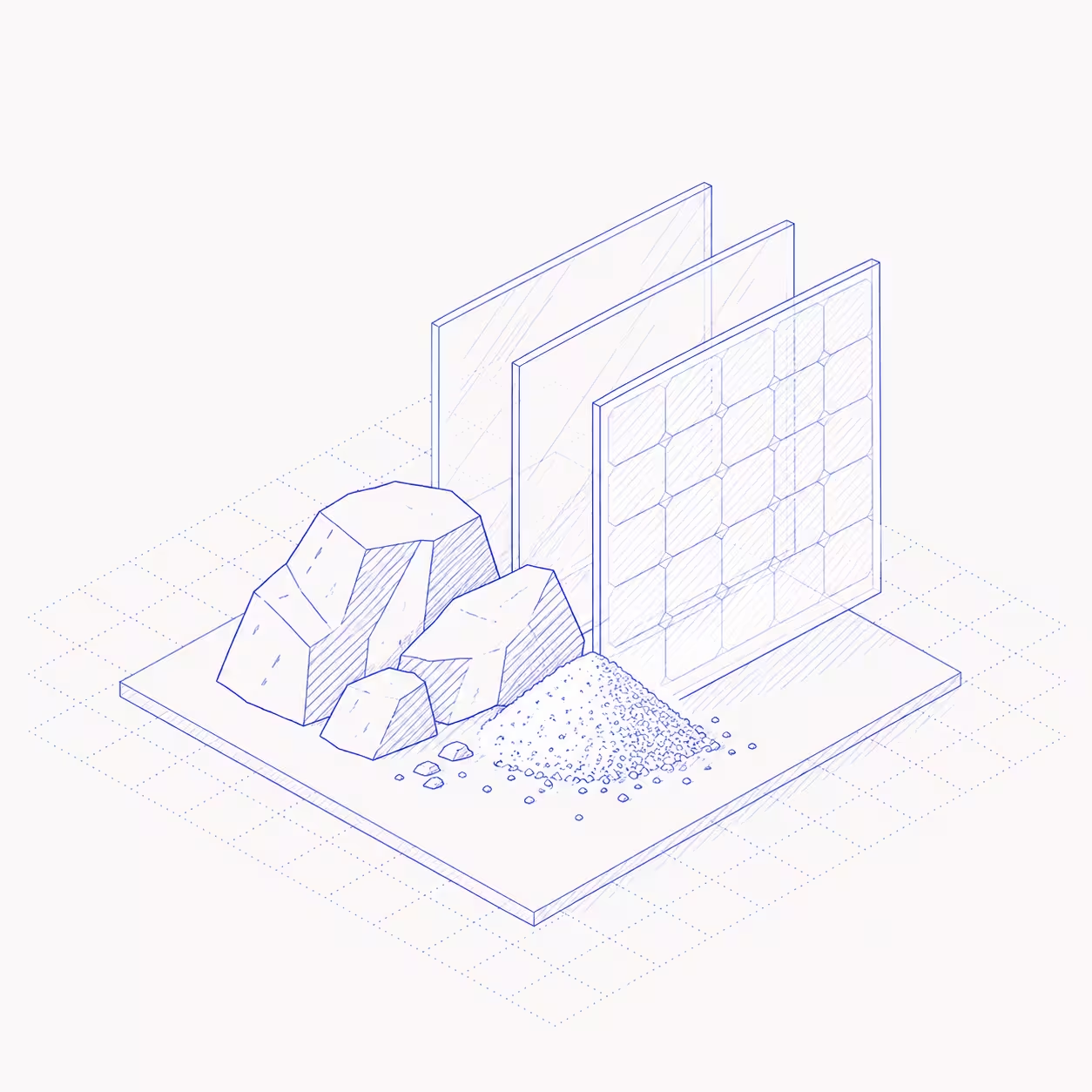
A tonne of float glass takes about 1.2 tonnes of virgin batch: roughly 726 kg sand, 233 kg soda ash, 188 kg dolomite and 52 kg calcium carbonate. In float glass, dolomite carries most of the CaO, so the calcium carbonate line is small but must stay steady. Specify CaO, Fe2O3, MgO, SiO2 and particle size as bands, proved on consecutive lots.
A float furnace runs day and night, often for years. All the while, a weighed batch goes in: sand, soda ash, dolomite, calcium carbonate and broken glass.
Most buyers can name those materials. Fewer can say how much of each goes into a tonne of glass. That number decides how tight each specification needs to be.
Glass raw materials for float glass are silica sand, soda ash, dolomite, calcium carbonate and cullet, plus minor additives such as salt cake. Worked from a typical float composition, one tonne of glass takes about 1.2 tonnes of virgin batch. That is roughly 726 kg sand, 233 kg soda ash, 188 kg dolomite and 52 kg calcium carbonate.
This note covers what each material does, the calculation, how glass types differ, and what to specify for the calcium input. For the everyday version, see what glass is made of.
What glass raw materials go into a float batch?
A float batch is built from one glass former, one flux, two calcium carriers, recycled glass and a few minor additives. The EU reference document on glass manufacturing (BREF) gives a typical float composition of 72.6% SiO2, 13.6% Na2O, 8.6% CaO and 4.1% MgO.
Read the table below as one tonne of float glass made from virgin raw materials.
| Raw material | kg in 1 t of glass | Supplies | Job in the glass |
|---|---|---|---|
| Silica sand | 726 | SiO2 | Forms the glass network |
| Soda ash (Na2CO3) | 233 | Na2O | Flux: lowers the melting temperature |
| Dolomite (CaMg(CO3)2) | 188 | CaO and MgO | Stabiliser; brings the MgO float glass carries |
| Calcium carbonate (CaCO3) | 52 | CaO | Stabiliser: makes the glass durable |
| Salt cake (Na2SO4) | Small, up to about 1% of batch | Na2O, SO3 | Fining: helps clear bubbles from the melt |
| Cullet | None in this case | Glass | Melts with less energy than raw batch |
The BREF also lists carbon as a reducing agent, feldspar as a source of alumina, and iron oxide as a colouring agent for green and amber glass.
How does the float batch add up?
The batch is worked backwards from the glass. Each oxide is divided by its share in the raw material, because carbon dioxide leaves the furnace and the oxide stays.
- MgO first. Pure dolomite is 21.86% MgO. So 41 kg MgO ÷ 0.2186 = 188 kg dolomite.
- CaO from dolomite. Pure dolomite is 30.41% CaO, so 188 kg brings 57 kg of the 86 kg CaO needed.
- CaO from calcium carbonate. The other 29 kg ÷ 0.5603 (CaO in pure CaCO3) = 52 kg. At 53% CaO, it is about 55 kg.
- Na2O. 136 kg ÷ 0.5848 (Na2O in pure soda ash) = 233 kg soda ash.
- SiO2. Taking sand as pure silica, 726 kg.
The total is about 1,198 kg of batch for 1,000 kg of glass, and about 209 kg leaves as carbon dioxide. A glass technology course by CelSian puts float glass at 1,200–1,220 kg of dry batch per tonne. The small gap is the alumina, potash and fining agents left out here.
For the calcium buyer, two things follow. In this batch, dolomite supplies two-thirds of the CaO and calcium carbonate one third. A plant that uses less dolomite moves that CaO onto calcium carbonate. With no dolomite at all, the full 86 kg of CaO takes about 154 kg.
Cullet scales every line down. At the 20% cullet the BREF calls typical for float furnaces, the calcium carbonate line falls to about 41 kg. This is illustrative arithmetic, not a recipe.
How do float, container and solar glass differ?
Float, container and solar glass are all soda-lime glass, but each asks something different of the calcium input. Float glass carries more MgO than container glass, and solar glass carries far less iron than either.
Read the table below as a guide to which line tightens for which glass.
| Line | Float (clear) | Container | Solar (extra clear) |
|---|---|---|---|
| Typical glass CaO / MgO | 8.6% / 4.1% | 9–12% / 0.2–3.5% | Set by plant recipe |
| CaO from calcium carbonate | About a third in the worked batch | Often more, as less MgO means less dolomite | More where dolomite is cut |
| Fe2O3 in the calcium input | Set by the tint target | Flint: low, as for float. Amber and green: more tolerant | Set by the 120 ppm IS 5437 glass limit |
Final specifications should always be confirmed by the buyer's technical or quality team.
Solar glass has its own arithmetic, set out in low-iron raw materials for solar glass. For the Indian market picture, read India's glass industry and the purity gap.
What should a float plant specify for calcium carbonate?
A float plant should specify calcium carbonate on five lines, each with a band and a test method.
- CaO, on one basis. The batch is calculated on CaO, so CaO drift becomes glass drift. Agree a minimum and a band, and fix whether results are reported as CaO or CaCO3. See how to read a certificate of analysis.
- Fe2O3. Iron colours the glass and cannot be removed from the melt. Set the limit from the tint target and the kg the batch uses. One published example from CelSian sets Fe2O3 below 0.10% for limestone and dolomite.
- MgO and SiO2. Both enter the batch calculation. A shift in either moves the CaO and MgO balance or the sand line.
- Particle size. Coarse grains melt slowly. Fines raise dust and can be carried out of the furnace, which the BREF links to particle size and batch moisture. The Indian Bureau of Mines notes that the glass industry uses calcite at 20–80 mesh (about 0.18–0.85 mm).
- Consistency. A float furnace cannot stop for a bad lot. Ask for results on consecutive lots, not one sample.
In India, the reference standards are IS 997:2026 for limestone and dolomite for the glass and ceramic industry, and IS 488:2025 for glass making sands. Both replaced editions from 1973 and 1980, so check older purchase specifications against the current texts.
Where Dr. Lime fits
For buyers evaluating a calcium input for float or container glass, Dr. Lime offers grades for float, solar and specialty glass, drawn from a single-source deposit in Nagaur, Rajasthan. The table below gives the published limits.
| Grade | Use | CaO | Fe2O3 | MgO | SiO2 | Size |
|---|---|---|---|---|---|---|
| Glass Pure | Float glass | ≥ 53% | ≤ 0.06% | ≤ 1.5% | ≤ 2.0% | 0.125–2.0 mm; 0.25–1 mm |
| Base Pure | Container and coloured glass | ≥ 50% | ≤ 0.10% | ≤ 3% | ≤ 4% | 1–2 mm; 1.5–2.5 mm |
Final specifications should always be confirmed by the buyer's technical or quality team.
For solar glass, the low-iron grade is Solaris Pure. Dr. Lime measures particle size distribution by laser analysis and offers custom PSD. Certificates of Analysis are available on request.
Glass teams working through their own batch can talk to the Dr. Lime team about samples and trial lots.
Calculate the batch, then write the spec
Every float plant buys much the same materials. What differs is how much of each goes into a tonne, and how much drift the furnace can absorb.
So work the batch first. It shows which line carries the weight, and how tight each specification has to be.
The list names the materials. The batch sets the spec.
FAQs
What are the main raw materials for float glass?
Float glass is made mainly from silica sand, soda ash, dolomite and calcium carbonate, with cullet (recycled glass) and a small amount of salt cake. Sand forms the glass network, soda ash lowers the melting temperature, and dolomite and calcium carbonate supply the calcium oxide that makes the glass durable. Dolomite also supplies magnesium oxide.
How much calcium carbonate goes into a tonne of float glass?
In a worked float batch based on a typical composition of 8.6% CaO and 4.1% MgO, a tonne of glass needs about 52 kg of pure calcium carbonate, because dolomite supplies two-thirds of the CaO. A plant using no dolomite would need about 154 kg. Cullet reduces both figures in proportion.
What does dolomite do in float glass?
Dolomite supplies both calcium oxide and magnesium oxide to float glass. A typical float composition carries about 4% MgO, and dolomite is the usual source of it. In a worked batch, dolomite also supplies about two-thirds of the calcium oxide, so the iron and consistency of the dolomite count heavily in the batch.
What particle size of calcium carbonate is used in glass making?
The Indian Bureau of Mines notes that the glass industry uses calcite at 20–80 mesh, about 0.18–0.85 mm. Glass plants limit both ends of the range: oversize grains melt slowly, while fines raise dust and can be carried out of the furnace. The exact band should suit the plant's sand and batch handling.
How much cullet is used in float glass?
Float furnaces typically run with around 20% cullet, within a range of about 10–40%, according to the EU reference document on glass manufacturing. Cullet is recycled glass. Cullet melts with less energy than raw batch because no carbonates need to decompose, and one tonne of cullet replaces about 1.2 tonnes of virgin raw material.
Does Dr. Lime supply calcium carbonate for float glass?
Yes. Glass Pure is Dr. Lime's float glass grade, with CaO of at least 53% and limits of 0.06% Fe2O3, 1.5% MgO and 2.0% SiO2, in 0.125–2.0 mm and 0.25–1 mm sizes. Base Pure serves container and coloured glass. Certificates of Analysis are available on request.