

Hydrated Lime, Slaked Lime, Ca(OH)2: One Material, Many Names


Chuna, slaked lime, fat lime, milk of lime and Ca(OH)2 are one material. But some products sold under the same names are not hydrated lime at all, and genuine hydrated lime comes in grades that suit very different jobs. This guide sorts out the names, the look-alikes, how hydrated lime is made, and how its grades differ.
A paan shop calls it chuna. A plasterer calls it fat lime. A water treatment plant orders hydrate, or doses it as milk of lime. A chemist writes Ca(OH)2.
It is the same white powder.
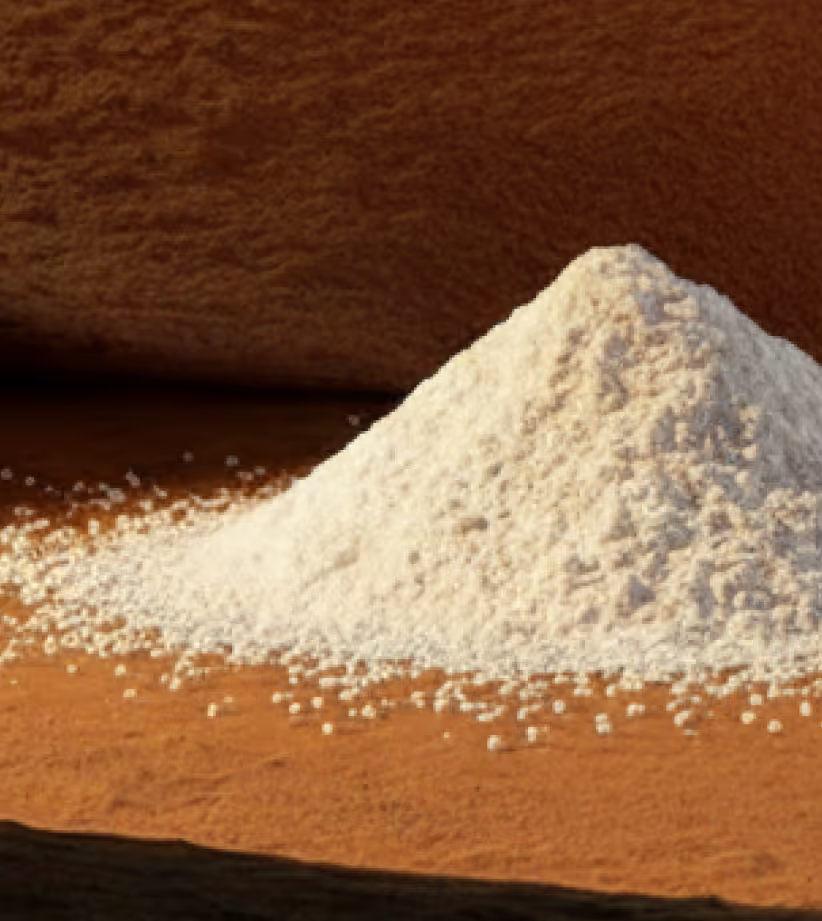
Hydrated lime is calcium hydroxide, Ca(OH)2: a dry white powder made by adding just enough water to quicklime. It is also called slaked lime, and in India simply chuna. Strongly alkaline, it treats drinking water and effluent, cleans flue gas, makes chemicals such as bleaching powder, and goes into lime mortar and plaster.
The many names would be harmless if they all pointed to the same thing. They do not. Some products sold under the same words are not hydrated lime at all, and even genuine hydrated lime comes in grades that suit very different jobs.
This article sorts out the names, the look-alikes, how hydrated lime is made, how its grades differ, and where Indian industry uses it.
One material, many names
Most names for hydrated lime describe its form, its use or the region it is sold in. The chemistry underneath stays the same.
Read the table below as a translation guide.
| Name you will hear | What it usually means | Chemistry |
|---|---|---|
| Hydrated lime, hydrate | The dry powder, the standard industrial form | Ca(OH)2 |
| Slaked lime | The same material; the older name, from "slaking" quicklime with water | Ca(OH)2 |
| Calcium hydroxide | The chemical name | Ca(OH)2 |
| Chuna | The everyday Indian word, from paan chuna to safedi on walls | Usually Ca(OH)2 |
| Fat lime, high-calcium lime | Building lime for finishing plaster and whitewash (IS 712, Class C) | Ca(OH)2 |
| Lime putty | Hydrated lime as a thick paste, aged for plaster work | Ca(OH)2 and water |
| Milk of lime, lime slurry | Hydrated lime suspended in water, dosed as a liquid | Ca(OH)2 in water |
| Dolomitic hydrate | Made from burnt dolomite, so it carries magnesium | Ca(OH)2 with magnesium compounds |
A few rows need a word of caution. "Chuna" is used loosely across India, sometimes for quicklime and sometimes even for limestone. Dolomitic hydrate is a close cousin rather than a twin, because the magnesium changes how it behaves. And the chuna sold for paan is a food-grade product; industrial hydrated lime is not meant to be eaten.
The Bureau of Indian Standards draws a useful line here. In IS 1540, "lime" means quicklime and hydrated lime in their various forms. By that definition, limestone is not lime at all. It is the rock lime is made from.
That is where the confusion starts to cost money.
What hydrated lime is not
Three materials are regularly sold, ordered or searched for under names that sound like hydrated lime.
Quicklime (CaO). Quicklime is the step before hydrated lime. It is more concentrated and reacts violently with water, releasing heat. A plant built to dose hydrated lime cannot simply switch to quicklime, and quicklime needs drier, tighter storage.
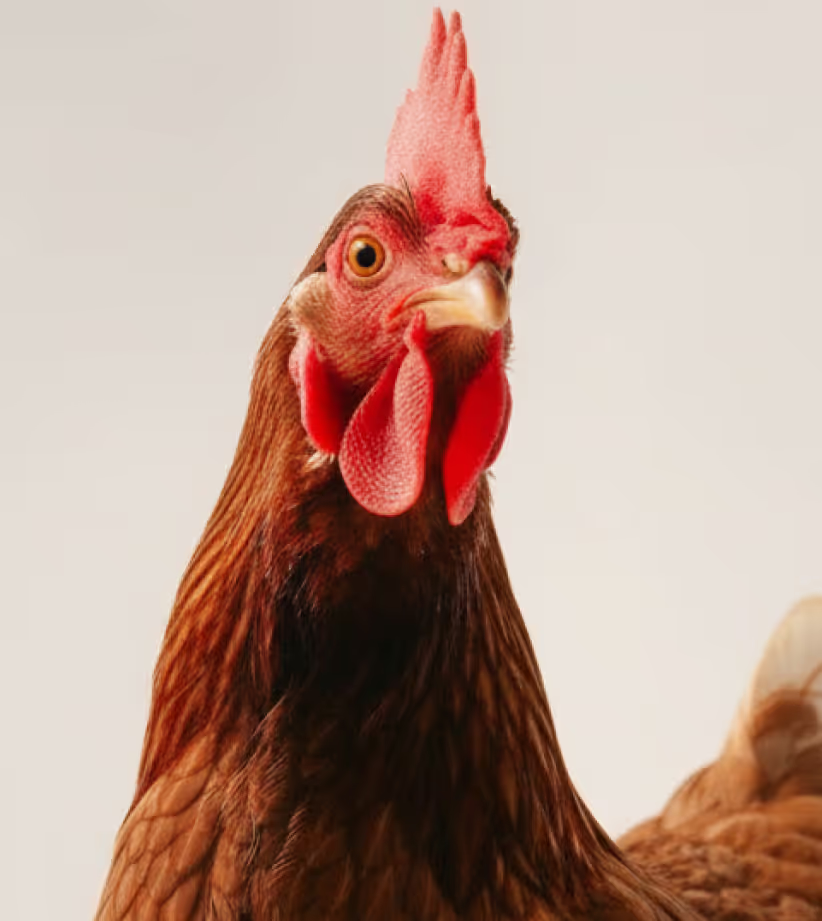
Limestone powder (CaCO3). This is the most common mix-up, because limestone powder is widely sold as "lime powder." Poultry farming shows why the difference matters. The calcium in layer feed comes from limestone, which birds can safely eat. Hydrated lime is caustic. On a farm it belongs to shed sanitation, not to the feed. Buyers looking for limestone for poultry feed should check that "lime powder" on the label means CaCO3.
Hydraulic lime. Some building limes, classed as eminently or semi-hydraulic under IS 712, are made from limestone that contains clay. The silicates this forms let them set even under water. They are useful building materials, but they are not the high-calcium hydrated lime used in chemical and water treatment.
Same word on the bag. Different chemistry in the process.
How hydrated lime is made
Hydrated lime starts as quicklime, and one reaction turns one into the other:
CaO + H2O → Ca(OH)2
In a modern plant, quicklime is crushed and fed into a hydrator, where it is mixed with a carefully measured amount of water. IS 1540 describes the target well: enough water to satisfy the quicklime's chemical affinity for water, and no more.
The reaction releases a great deal of heat. That heat turns any small excess of water into steam, which carries the extra moisture away. What remains is a dry, fine white powder.
The powder is then air-classified. This step separates the fine hydrate from particles that did not react properly: under-burnt cores of limestone, over-burnt lumps of lime, and grit. The fine fraction may be milled further to reach a target fineness.
Traditional slaking works differently. Quicklime goes into pits with excess water and is left to form a thick paste, lime putty. It suits plasterers, but it is not a dry, dosable industrial product.
Water control matters in both directions. Too little water leaves unhydrated CaO in the powder, which can keep reacting after use. In plaster, that shows up as pitting and popping weeks later. Too much water leaves a damp, lumpy product that does not flow or dose evenly.
Hydrated lime quality is set in three places: the limestone, the kiln and the hydrator. A good hydrator cannot fix under-burnt quicklime, and good quicklime cannot fix impure stone.
The stone end of that chain is where purity is decided, and our guide to the impurities buyers check in limestone covers it in detail.
Quicklime or hydrated lime: which should a plant buy?
The water in hydrated lime stays in the product. One tonne of quicklime becomes about 1.32 tonnes of hydrated lime, so a tonne of hydrate carries only about 76% of the calcium oxide in a tonne of quicklime. The buyer pays freight on the rest.
That is why large users, such as sugar mills, often buy quicklime and slake it on site. Smaller users usually buy ready hydrate, because it is safer to store and simpler to dose.
What separates one hydrated lime from another
Two bags can both say "hydrated lime" and still perform very differently. The difference shows up in a handful of numbers.
Read the table below as a checklist for a hydrated lime test report.
| Parameter | Why buyers check it |
|---|---|
| Available lime (as Ca(OH)2) | The part that actually reacts. It sets how much hydrate the process consumes. |
| CO2 or CaCO3 content | Signals under-burnt cores, or hydrate that has absorbed CO2 from the air in storage. |
| Dead-burnt and unhydrated lime | Inert in the process or, worse, reacts late. |
| MgO | Separates high-calcium hydrate from dolomitic hydrate. |
| Acid insolubles (as SiO2), Fe2O3, Al2O3 | Add to residue and sludge, and can affect colour in finished products. |
| Fineness | Finer hydrate reacts faster. For flue gas treatment, special high-surface-area grades are made to react faster still. |
| Moisture | A sign of how well hydration was controlled, and part of the weight a buyer pays for. |
Final specifications should always be confirmed by the buyer's technical or quality team.
India's own standard makes the point clearly. IS 1540 (Part 2) specifies hydrated lime for chemical industries in three grades, each tied to a use.
| Grade | Intended use under IS 1540 (Part 2) | Available lime as Ca(OH)2, minimum |
|---|---|---|
| A | Grease manufacture | 90% |
| B | Stable bleaching powder manufacture | 88% |
| C | Water treatment | 86% |
Each grade also carries impurity limits, such as magnesia and carbon dioxide, and grades B and C add limits on iron, alumina and dead-burnt lime. So even the national standard does not treat hydrated lime as one product. The name tells you the family. The grade tells you whether it suits your process.
Building limes follow a separate standard, IS 712, and IS 1514 sets out the methods for sampling and testing both quicklime and hydrated lime.
One storage note: hydrated lime is more stable than quicklime, but it still absorbs carbon dioxide from the air over time. Bag quality and time in the warehouse show up in the available lime figure.
Where hydrated lime is used
Hydrated lime is a strong but manageable alkali. That makes it useful wherever a process needs to neutralise acid, raise pH or supply calcium in a reactive form.
The table shows the main industrial uses, and what each type of buyer tends to watch.
| Industry | What hydrated lime does | What buyers usually check |
|---|---|---|
| Water and wastewater | Corrects pH, softens water, precipitates metals, conditions sludge | Available lime, insolubles, consistent dosing |
| Flue gas and emissions | Captures SO2, SO3 and HCl in dry sorbent injection and semi-dry scrubbers | Fineness, surface area, available lime |
| Chemicals | Raw material for bleaching powder, greases and calcium salts | Grade-specific purity |
| Leather | "Liming" hides to loosen hair before tanning | Consistency, low grit |
| Sugar | Milk of lime clarifies cane juice before crystallisation | Purity, low insolubles |
| Paper, paint and plastics | Milk of lime is carbonated with CO2 to make precipitated calcium carbonate (PCC), a fine white filler | Purity, whiteness, consistency |
| Agriculture | Mixed with copper sulphate to make Bordeaux mixture for crop protection; routine soil liming usually uses limestone instead | Purity, fineness |
| Construction | Fat lime mortar and plaster, whitewash, soil stabilisation, heritage repair | Fineness, soundness, IS 712 class |
Exact requirements vary by plant and process. Water utilities and effluent plants can start from the Grade C limits and our page on lime for water and effluent treatment. Chemical makers will find the same grade-by-use logic in lime materials for chemical processes.
One distinction matters for Indian power plants. Most wet FGD systems in India run on limestone for wet FGD, not hydrated lime. Hydrated lime belongs to dry and semi-dry systems.
Hydrated lime in India: from chuna to chemical reagent
India has made hydrated lime for a very long time. Lime plaster and whitewash run through the country's building tradition, and Rajasthan remains a major base for the trade today.
Much of that trade grew up around construction and general use. For whitewashing a wall or mixing a mortar, "chuna" was specification enough.
The uses growing fastest now are different. Municipal water treatment, industrial effluent limits, flue gas control and chemical manufacturing do not buy chuna. They buy a reagent. They dose it by weight, expect a fixed response, and need documented available lime, controlled fineness and tight impurity limits, load after load.
That shift is quietly changing what the market asks for. Buyers are moving from asking for a name to asking for a specification.
Where Dr. Lime fits
Hydrated lime is part of Dr. Lime's product roadmap. It is currently in the development phase, engineered for treatment, environmental control and chemical processing systems.
The roadmap follows the chain this article has described. Limestone comes first, then quicklime, which is in its engineering phase for 2027 in Maerz kilns, then hydrated lime, and beyond it precipitated calcium carbonate (PCC), which is in its design phase.
That order matters, because hydrate quality is set in the stone before it is set anywhere else. Dr. Lime controls quality from the extraction stage. Its material comes from a controlled, single-source deposit with up to 96% calcium carbonate content, and it already supplies high-purity limestone products for glass, FGD, feed and other specification-driven applications.
If your process runs on hydrated lime, or you want to see how limestone and kiln quality carry through to the hydrate, the Dr. Lime team can help you work through the chemistry for your application.
Read the spec, not the name
Chuna, slaked lime, fat lime, milk of lime and Ca(OH)2 are, for the most part, one material.
But the name on the bag only tells you the family. Available lime, fineness and impurities tell you the grade, and the grade decides whether it works in your process.
With hydrated lime, the name is where the conversation starts. The specification is where it should end.
FAQs
What is hydrated lime?
Hydrated lime is calcium hydroxide, Ca(OH)2, a dry white powder made by adding a controlled amount of water to quicklime. It is strongly alkaline and is used in water and wastewater treatment, flue gas cleaning, chemical manufacturing, leather processing, sugar refining and construction.
Is hydrated lime the same as slaked lime?
Yes. Hydrated lime and slaked lime are two names for calcium hydroxide, Ca(OH)2. "Slaked lime" is the older term, from slaking quicklime with water, while "hydrated lime" usually refers to the dry industrial powder made in a hydrator.
What is chuna called in English?
Chuna usually means slaked lime or hydrated lime, which is calcium hydroxide, Ca(OH)2. The paste used in paan and the lime used for whitewash are both forms of it. In everyday speech, chuna is sometimes also used loosely for quicklime or limestone, so buyers should confirm the chemistry on the specification.
What is the difference between hydrated lime and quicklime?
Quicklime is calcium oxide (CaO), made by heating limestone in a kiln. Hydrated lime is calcium hydroxide (Ca(OH)2), made by reacting quicklime with water. Quicklime is more concentrated and releases heat when wetted, while hydrated lime is a dry powder that is easier to store and dose.
Should a plant buy quicklime or hydrated lime?
It depends mainly on volume and handling. One tonne of quicklime becomes about 1.32 tonnes of hydrated lime, so hydrate carries less calcium oxide per tonne and costs more to transport per unit of lime. Large users often buy quicklime and slake it on site, while smaller users usually prefer ready hydrated lime because it is safer to store and simpler to dose.
Is hydrated lime the same as limestone powder?
No. Limestone powder is calcium carbonate (CaCO3), ground natural rock, and is often sold as "lime powder." Hydrated lime is calcium hydroxide (Ca(OH)2), which is caustic and far more reactive. The two are not interchangeable, for example in animal feed, where the calcium source is limestone.
Is hydrated lime safe to handle?
Hydrated lime is strongly alkaline, with a pH of about 12.4 in water, and can irritate or burn skin, eyes and airways. It should be handled with gloves, eye protection and dust control, and stored dry. Buyers should follow the supplier's safety data sheet for each grade.
Is chuna safe to eat?
Chuna used in paan or food preparation must be a food-grade product, made and handled for that purpose. Industrial hydrated lime is not produced for consumption and should never be eaten. Even food-grade lime is strongly alkaline and can burn the mouth, skin and eyes if mishandled.
What is the Indian standard for hydrated lime?
IS 1540 (Part 2) specifies hydrated lime for chemical industries in three grades: A for grease manufacture, B for bleaching powder and C for water treatment, with minimum available lime of 90%, 88% and 86% respectively. Building limes are covered by IS 712, and IS 1514 sets out the methods of sampling and testing.
Does Dr. Lime supply hydrated lime?
Hydrated lime is part of Dr. Lime's product roadmap and is currently in the development phase, aimed at treatment, environmental control and chemical processing. Today, Dr. Lime supplies high-purity limestone products for glass, FGD, feed and other industrial applications. Plants planning future hydrated lime needs can contact the Dr. Lime team.