


Lime Manufacturers in India: How to Evaluate Quality and Consistency
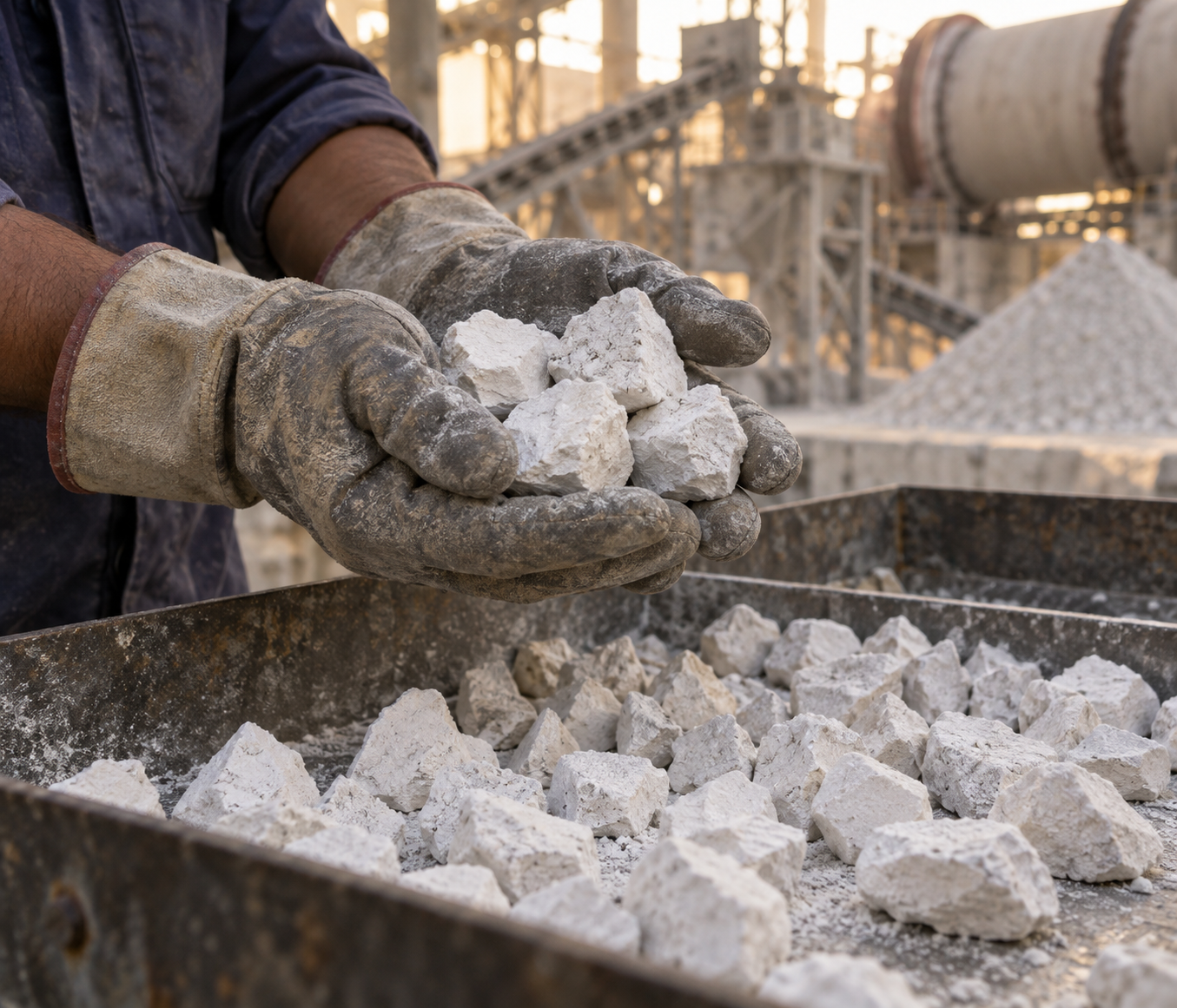

Nearly every lime manufacturer in India describes itself as leading or trusted, but none of those claims tells a buyer how to check. This guide sets out six checks that follow lime from the stone to your plant gate, from kiln control and lot testing to consistency data and packing, plus a checklist to run before approving a supplier.
Search for lime manufacturers in India and a pattern appears quickly. Nearly every result describes itself as leading, trusted or number one. Many of those claims may well be sincere. But none of them tells a buyer how to check.
That matters more for lime than for most materials, because lime is not simply dug out of the ground. It is made, and it keeps changing after it is made.
To evaluate a lime manufacturer in India, look past the price and the "leading supplier" claims. Check the limestone it burns, how it controls its kiln and hydrator, whether every lot is tested for available lime, reactivity and CO2, how consistent those results are over months, and how the lime is packed so it arrives as it left.
This guide follows lime from the stone to your plant gate in six checks, then gives a checklist to run before you approve a supplier.
A lime manufacturer runs three processes, not one
Limestone is extracted and processed. Lime is manufactured. Stone goes into a kiln and comes out as quicklime. For hydrated lime, that quicklime then goes through a hydrator. After that, it is packed, stored and transported to your plant.
Each stage can undo the one before it. Good stone can be spoilt by a badly run kiln. Good quicklime can be spoilt by damp packing or a long journey.
A good test report at the kiln does not guarantee good lime at your plant.
The six checks below follow that chain.
| Check | The question to ask |
|---|---|
| 1. The stone | What limestone goes into the kiln? |
| 2. The kiln | How is burning controlled? |
| 3. The hydrator | For hydrated lime, how are water and fineness controlled? |
| 4. Lot testing | What is tested, how often, and by whom? |
| 5. Consistency | What do the last six to twelve months look like? |
| 6. Packing and delivery | Does the lime arrive as it left? |
Check 1: The stone it burns
Lime cannot be purer than the limestone it is made from. Impurities in the stone do not burn off in the kiln. As carbon dioxide leaves, the silica, iron, alumina and magnesium stay behind, so their share of the finished lime rises.
So the first questions are about the stone. Does the manufacturer control its limestone source, or buy stone on the open market? How many sources feed one kiln? Does it keep chemistry records for the stone going in?
A kiln fed from several sources has to cope with several chemistries. The full framework for judging the stone itself is in our guide on how to evaluate a limestone supplier in India.
Check 2: How the kiln is controlled
Lime is made in several kinds of kiln in India, from vertical shaft kilns to parallel-flow regenerative (PFR) kilns and rotary kilns. A well-run small kiln can outperform a poorly run large one.
Kiln type is not the verdict. Control is.
In practice, control means the manufacturer monitors temperature and fuel, and tracks two numbers for every lot. Residual CO2 shows lime that was under-burnt, with a core of unreacted limestone. Reactivity shows lime that was over-burnt and has become slow to react.
Ask about fuel too. Many Indian lime kilns burn pet coke, and its price moves, so ask how fuel costs pass into the lime price. That mechanism is part of supply reliability.
Check 3: For hydrated lime, how the hydrator is run
Hydrated lime adds a second manufacturing step, and a second place for quality to slip.
Water control is the heart of it. Too little water leaves unhydrated CaO in the powder, which can keep reacting after it reaches your process. Too much leaves a damp, lumpy product that does not flow or dose evenly.
After hydration, air classification separates the fine hydrate from unburnt cores, over-burnt lumps and grit. This is where fineness is set.
Ask whether hydration happens in a controlled hydrator or by manual or pit slaking, and how fineness and moisture are checked for each lot.
Check 4: What is tested, how often, and by whom
A lime certificate that shows only CaO tells you very little. Read the table below as the minimum a lime test report should cover.
| Test | What it tells you | Where the method comes from |
|---|---|---|
| Available lime (as CaO or Ca(OH)2) | How much of the lime will actually react | IS 1514 |
| Carbon dioxide | Under-burnt lime, or lime that has absorbed CO2 in storage | IS 1514 |
| Reactivity or slaking rate | How fast the lime reacts in your process | EN 459-2; ASTM C110 |
| Dead-burnt lime | Lime that will not react at all | IS 1514 |
| Acid insolubles, Fe2O3, Al2O3, MgO | Impurities carried over from the stone | IS 1514; IS 1540 |
| Fineness and moisture (hydrated lime) | Dosing, flow, and how well hydration was controlled | IS 1514 |
IS 1540 (Part 1): 1980 sets three grades of quicklime for chemical industries, each tied to a use.
| Grade | Intended uses under IS 1540 (Part 1) | Available lime as CaO, minimum |
|---|---|---|
| A | Bleaching powder, paper, textiles, varnish | 92% |
| B | Sugar, calcium carbide | 90% |
| C | Soda ash, caustic soda, water treatment, tanning | 85% |
IS 1540 (Part 2): 1990 does the same for hydrated lime, at 90%, 88% and 86% available Ca(OH)2. Building limes are covered separately by IS 712. Water utilities, for example, can start from the Grade C limits and our page on lime for water treatment.
Note what IS 1540 (Part 1) leaves out. It does not cover lime for building, agricultural, metallurgical, glass or ceramic use. Steel plants and other buyers outside its scope often buy against their own plant specifications, which makes a manufacturer's testing discipline even more important.
Then ask how the testing is done. Is every lot tested, or only a monthly composite? Is the in-house lab checked periodically by an independent, NABL-accredited laboratory? Are retained samples kept for each lot? And does every bag or consignment carry a batch number? Both parts of IS 1540 require one on the package, and Part 2 says it is there "to enable the material to be traced from records."
A typical value and a guaranteed limit are also not the same promise, as our guide to typical values versus guaranteed specifications explains.
Final specifications should always be confirmed by the buyer's technical or quality team.
Check 5: Consistency over months, not one good sample
Every manufacturer can produce one good sample. The question is what the next hundred lots look like.
Ask for six to twelve months of lot results for available lime, residual CO2 and reactivity. Look at the range, not the average. A healthy average can hide individual lots well below your limit.
Then ask two harder questions. What happens to a lot that fails specification: is it held, blended, reworked, or dispatched with notice? And will the manufacturer tell you before it changes its stone source, its fuel or its kiln settings? Any of those changes can move your results even while the certificate still passes.
Check 6: Packing, transit and receipt
Lime keeps reacting after it leaves the kiln, so the lime that arrives can be weaker than the lime that was tested.
The carbon dioxide limit in IS 1540 (Part 1) reflects this: it applies to a sample taken at the place of manufacture, not at the buyer's gate. Unless buyer and supplier agree otherwise, the same standard expects bulk quicklime to travel in closed wagons and smaller lots in air-tight or moisture-proof containers. For hydrated lime, IS 1540 (Part 2) specifies polyethylene-lined bags, again unless agreed otherwise.
Much of India's merchant lime comes from clusters such as the Jodhpur region of Rajasthan and Katni in Madhya Pradesh, so for many buyers it travels a long way before use.
So ask how the lime is packed, whether in bulk tankers, sealed bags or jumbo bags. Ask how long it takes to travel from kiln to plant, how much stock is held and where, whether supply holds through the monsoon, and what happens when a kiln stops for relining or repairs.
At receipt, sample it properly. IS 1514 says samples should not be taken at a place exposed to the weather or from damaged packages, and should be kept in airtight containers. Then compare the result with the dispatch certificate.
The lime buyer's checklist
A site visit answers most of these questions faster than any brochure. Before approving a lime manufacturer, run the conversation through this table.
| What to ask | Weak answer | Strong answer |
|---|---|---|
| Where does your kiln feed come from? | Bought stone, source varies | Controlled source, stone chemistry recorded |
| How do you control burning? | Operator experience | Residual CO2 and reactivity tracked per lot |
| How is hydration controlled? | Manual or pit slaking | Controlled hydrator and classifier, fineness checked per lot |
| What is on the certificate? | CaO only | Available lime, CO2, reactivity, impurities, fineness and moisture, with methods named |
| Can you show consistency? | One recent report | Six to twelve months of lot data, with ranges |
| What happens to an off-spec lot? | No stated rule | Held, and the buyer is notified |
| How is it packed and delivered? | Open or unlined bags | Moisture-proof packing, known transit time, batch number on every package |
| Will you tell us about changes? | No commitment | Advance notice of changes in stone, fuel or process |
| Can you cover our volume if a kiln stops? | Spot availability only | Capacity above committed volumes, stock held, a plan for shutdowns |
| Do you hold a valid consent to operate? | Unclear or expired | Current consent to operate from the State Pollution Control Board |
| Do you provide a safety data sheet? | Not available | Safety data sheet and handling guidance for each product |
A manufacturer that gives strong answers across this table is worth a trial order. One that cannot answer the first four rows will struggle to hold your specification, however good its first sample looks.
Where Dr. Lime fits
This guide began with a simple point: lime cannot be purer than the stone it is made from. That first link in the chain is where Dr. Lime works today.
Dr. Lime controls quality from the extraction stage. Its material comes from a controlled, single-source deposit with up to 96% calcium carbonate content, and is processed in-house into high-purity limestone products built to defined specifications. The chemistry is known before any kiln is lit.
Dr. Lime does not make lime yet. Its high-reactivity quicklime is in the engineering phase, planned for 2027 and to be made in Maerz kilns for controlled calcination and consistent performance. Hydrated lime is in development, for treatment, environmental control and chemical processing.
When those products launch, they should be held to the same six checks as any other lime manufacturer's.
If your plant is reviewing its lime supply or planning ahead, the Dr. Lime team can help you work through the specification.
Judge lime where you use it
The right lime manufacturer is not the one with the loudest claim or the lowest quote. It is the one whose lime still meets your specification when it reaches your plant, lot after lot.
The kiln gate is where lime is made. Your plant gate is where it is judged.
FAQs
Who are the top lime manufacturers in India?
The top lime manufacturer for any buyer depends on the grade, volume, location and documentation that buyer needs. Rather than relying on rankings or "leading supplier" claims, buyers should check the manufacturer's limestone source, kiln control, lot testing, six to twelve months of consistency data, and packing and delivery practices.
What should buyers check before choosing a lime manufacturer?
Buyers should check six things: the limestone the manufacturer burns, how it controls its kiln, how it runs its hydrator for hydrated lime, what it tests on every lot, how consistent its results are over several months, and how the lime is packed and delivered. Together, these show whether the lime will meet specification at the buyer's plant, not just at the kiln.
What should a lime Certificate of Analysis include?
A lime Certificate of Analysis should include available lime, carbon dioxide, reactivity or slaking rate, dead-burnt lime and impurities such as acid insolubles, Fe2O3, Al2O3 and MgO, with the test method named. For hydrated lime, it should also include fineness and moisture. Each certificate should carry a batch number that links it to the material supplied.
What is available lime, and why does it matter?
Available lime is the part of quicklime or hydrated lime that actually takes part in a reaction under a specified test method. It matters because it sets how much lime a process consumes. Two products with the same total CaO can have different available lime, depending on how well the stone was burnt and how the lime was stored.
Which Indian standards apply to quicklime and hydrated lime?
IS 1540 (Part 1): 1980 covers quicklime for chemical industries, and IS 1540 (Part 2): 1990 covers hydrated lime for chemical industries. IS 712 covers building limes, and IS 1514 sets out the methods of sampling and testing. IS 1540 (Part 1) does not cover lime for building, agricultural, metallurgical, glass or ceramic use.
How can buyers check lime quality when it arrives?
Buyers should sample lime at receipt using the precautions in IS 1514: not at a place exposed to the weather, not from damaged packages, and kept in airtight containers. The results should then be compared with the dispatch certificate for the same batch number, especially for available lime and carbon dioxide.
Why does lime quality change during transport and storage?
Quicklime and hydrated lime absorb moisture and carbon dioxide from the air, which lowers their available lime over time. Moisture-proof packing, shorter transit times and dry storage limit this change. This is why IS 1540 (Part 1) measures its carbon dioxide limit on a sample taken at the place of manufacture.
Does Dr. Lime manufacture lime?
Not yet. Dr. Lime's quicklime programme is in its engineering phase, to be made in Maerz kilns from 2027, and hydrated lime is in development. Today, Dr. Lime supplies high-purity limestone products from a controlled, single-source deposit with up to 96% calcium carbonate content.