


Calcite Powder Uses: Which Grade Each Industry Needs


Calcite powder is one mineral, calcium carbonate, used in ten or more industries, and each needs a different grade. Paint and paper want powder finer than 10 µm, ceramics want grains finer than 150 µm, and glass, water filters and layer feed use granules or grit. So name the use first, then set the fineness and the properties that use cares about.
A paint maker, a PVC pipe extruder and a layer farm can all send an enquiry for calcite powder. They are not asking for the same thing.
The paint maker needs powder finer than 10 microns. The layer farm wants grit up to 4 mm.
Same mineral. Different grade.
Calcite powder uses include paint, wall putty, PVC and other plastics, rubber, paper, adhesives and sealants, ceramics, animal feed, water treatment and glass. In each, the same calcium carbonate does a different job, so each needs its own grade. PVC takes fine, often coated powder; glass and water filters take granules; laying hens take coarse grit.
This note covers calcium carbonate powder uses in one table, then the properties and Indian standards behind it. For how to write a fineness spec, see calcium carbonate filler grades and fineness.
What is calcite powder?
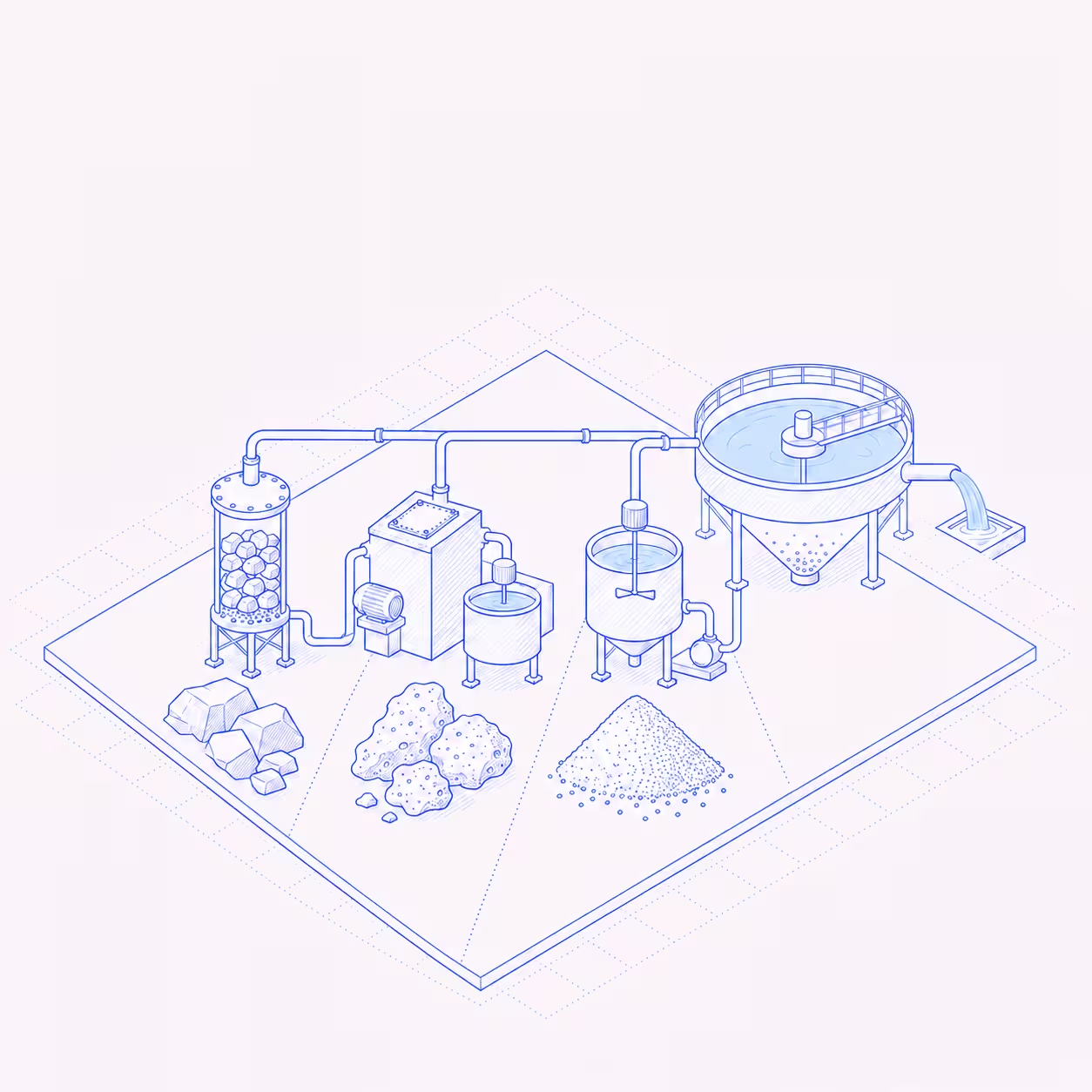
Calcite powder is ground calcite: natural calcium carbonate (CaCO3), also sold in India as whiting or ground calcium carbonate (GCC).
IS 15751:2007, the Bureau of Indian Standards (BIS) specification for calcite in ceramics, describes calcite as the essential mineral in limestone. It carries 56.03% CaO, is soft at 3 on the Mohs scale and is normally white.
The Indian Bureau of Mines notes that purity decides the use: calcite at 98% CaCO3 or more has the highest brightness. Rajasthan holds about 53% of India's calcite resources.
Precipitated calcium carbonate (PCC) shares the formula but is made chemically; see ground and precipitated calcium carbonate compared.
Calcite powder uses by industry, and the grade each needs
Calcite does one of five jobs: it fills, extends, fluxes, neutralises or feeds. The job sets the grade.
Find your industry, then read across. Values come from the named standard or sheet; "typical" marks common practice, not a requirement.
| Industry | What calcite does there | Typical fineness | Properties that matter |
|---|---|---|---|
| Paint | Extender in the paint film | IS 63 Grade 2: ≥ 96% finer than 10 µm; ≤ 0.2% on 37 µm | Whiteness and colour vs approved sample; oil absorption 15–25; no coating required |
| Wall putty | Main filler, with white cement and polymer | Finished putty about 40–100 µm (typical) | Whiteness; clean, grit-free powder for a smooth finish; moisture; uncoated (typical) |
| PVC pipe and profile | Filler for dimensional stability and lower compound cost | Fine: published rigid-PVC grades have D50 about 1.4–7 µm | Coated for rigid PVC, uncoated for plasticised; low silica; pipe sulphated ash ≤ 11% under IS 4985 |
| Rubber | Filler in rubber goods | IS 1685: ≤ 0.4% on 75 µm; ≤ 0.01% on 150 µm | CaCO3 ≥ 94%; Al2O3 + Fe2O3 ≤ 1%; manganese ≤ 0.03% and a copper test; moisture ≤ 0.5% |
| Paper | Filler for brightness and opacity | 70% or 90% finer than 2 µm | Brightness, about 95% reflectance (typical); few coarse particles; neutral or alkaline papermaking |
| Adhesives and sealants | Main filler, up to 55–60% in moisture-curing systems | Fine: one published sealant grade has D50 1.4 µm, top cut 6.1 µm | Moisture and moisture pick-up first; surface-treated (coated) grades |
| Ceramics | Glaze ingredient and CaO source | IS 15751: normally finer than 150 µm; ≤ 1.0% on 75 µm | CaCO3 ≥ 97%; Fe2O3 ≤ 0.5%; free iron ≤ 0.05%; white or off-white fired colour |
| Animal feed | Calcium source for eggshell and bone | Layers: 2–4 mm coarse plus 0–2 mm fine; fine powder for broilers | Calcium content and solubility; low acid insolubles and moisture |
| Water treatment | Calcite media dissolve to raise pH and add hardness | Granules: one published media is 0.425–1.18 mm (16 × 40 mesh) | CaCO3 ≥ 95%; MgCO3 ≤ 3%; uniform size; potable-water certification |
| Glass | CaO source and flux in soda-lime-silica glass | 20–80 mesh (about 0.18–0.85 mm), granular | CaCO3 ≥ 95%; CaO generally ≥ 54%; low, steady iron (typical) |
Final specifications should always be confirmed by the buyer's technical or quality team.
Sources by row. Paper: Hubbe and Gill (2016). PVC and sealants: Omya sheets for Omyacarb 6 and Omyacarb FT, and Kanademy.
Water: a Clack calcite media sheet. Feed: the Hy-Line Brown guide. Putty: a formulation guide.
Three of these uses are not powders at all. For feed grit, see calcium grit vs powder for layer hens and how much calcium goes into layer feed. For glass, see raw materials for float glass. For water, see lime and calcium carbonate in water treatment.
Which properties decide the grade?
After fineness, five properties separate one calcite grade from another: whiteness, oil absorption, purity, moisture and coating.
Whiteness or brightness. It matters wherever the product is white or tinted: paint, putty and paper. IS 63 judges it against an approved sample, so agree the sample and test before the first lot.
Oil absorption. This is the linseed oil needed to turn a set mass of powder into a paste. A higher value means the paint or putty needs more binder.
Purity and iron. Ceramic buyers watch iron because the fired colour must stay white. Rubber buyers also watch manganese and copper: even small amounts of either strongly speed up rubber ageing, especially in natural rubber.
Moisture. It matters most where water reacts. In moisture-curing sealants, filler can be 55–60% of the formula, so a small moisture figure still carries a lot of water. IS 63 and IS 1685 cap moisture or volatile matter at 0.5%; IS 15751 allows 2%.
Coating. A coated grade carries a fatty acid, usually stearic acid, so it disperses in polymers. Rigid PVC and moisture-curing sealants use coated grades.
Which Indian standards apply?
Three BIS standards cover calcite or whiting for a named end use: IS 63 for paint and putty, IS 1685 for rubber and IS 15751 for ceramics.
IS 63:2006 needs care. Its Grade 1 putty test kneads the powder with raw linseed oil, an oil-based putty. Modern wall putty is white cement-based polymeric putty, covered by IS 17545:2021, which sets requirements for the finished putty, not its filler. So putty makers agree the calcite spec with their supplier.
IS 1685 dates from 1975 (reaffirmed 2003), so check whether a newer edition applies.
Where Dr. Lime fits
CalFill is Dr. Lime's ground calcium carbonate filler. Its published quality options are CaCO3 ≥ 95%, MgO ≤ 1.5%, Fe2O3 ≤ 0.15%, Acid Insoluble ≤ 1.5% and Moisture ≤ 0.5%. Size is 100–400 mesh with a D50 of 30–100 µm, and custom grading is available.
Its listed uses are polymer and rubber compounding, industrial coatings, adhesives and construction fillers, plus LC3 and blended cement. For single-micron uses such as rigid PVC or paper, confirm grade availability with the team.
For the granular uses, Dr. Lime makes separate products: CaSure Grit, CaSure Powder and CaMoo38 for feed, Cal Hydro and pH Optima for water, and Glass Pure for float glass.
All come from a single-source deposit, with particle size distribution measured by volume using laser analysis and lot-level traceability. Certificates of analysis are available on request. The Dr. Lime team can match a grade to your use and arrange a trial sample.
Name the use before the grade
A grade that suits wall putty is too coarse for paper. A grade that suits paper is wasted in a feed mill.
Start every enquiry with the use. Then set the fineness and the limits that use cares about.
The mineral is the same everywhere. The grade is what you are buying.
FAQs
What are the main uses of calcite powder?
The main uses of calcite powder are as a filler or extender in paint, wall putty, PVC and other plastics, rubber, paper, and adhesives and sealants. Coarser calcite also serves as a glaze ingredient in ceramics, a calcium source in animal feed, a filter medium in water treatment and a calcium oxide source in glass. Each use needs its own grade.
Is calcite powder the same as calcium carbonate?
Calcite powder is natural calcium carbonate (CaCO3), ground from calcite, the mineral that makes up marble and most limestone. In India it is also sold as whiting or ground calcium carbonate (GCC). Precipitated calcium carbonate (PCC) has the same formula but is made chemically, with a different particle size and shape.
Which calcite powder grade is used in wall putty?
Wall putty usually takes a white, clean calcite powder as its main filler, bound by white cement and a polymer. One formulation guide puts fillers at 20–50% of the putty and the finished powder at about 40–100 µm. IS 17545:2021 covers the finished putty, not the filler, so agree whiteness, fineness and moisture with the supplier.
Which calcite powder is used in PVC pipes?
PVC pipes use a fine, coated calcite powder with low moisture and low silica. Published rigid-PVC grades have a median particle size (D50) of about 1.4–7 µm. In India, IS 4985 limits potable-water PVC pipe to a sulphated ash of 11% and a specific gravity of 1.46, which caps how much filler the pipe can carry.
What whiteness should calcite powder have for paint?
IS 63:2006, the Indian standard for whiting for paint and putty, does not set a fixed whiteness number. It requires colour, whiteness and opacity to closely match an approved sample. So the paint maker and the calcite supplier should agree a reference sample and a test method, then check every lot against it.
Is calcite powder used in glass and ceramics?
Yes. In glass, calcite supplies calcium oxide (CaO) and acts as a flux; the Indian Bureau of Mines gives 95% CaCO3 minimum and grains of 20–80 mesh. In ceramics, calcite is used in glazes, and IS 15751 asks for at least 97% CaCO3, at most 0.5% Fe2O3 and grains normally finer than 150 µm.
Does Dr. Lime supply calcite powder?
Yes. Dr. Lime makes CalFill, a ground calcium carbonate filler published at CaCO3 ≥ 95% and Fe2O3 ≤ 0.15%, 100–400 mesh with a D50 of 30–100 µm, with custom grading. Its listed uses are polymer and rubber compounding, coatings, adhesives and construction fillers. Specifications and certificates of analysis are available on request.